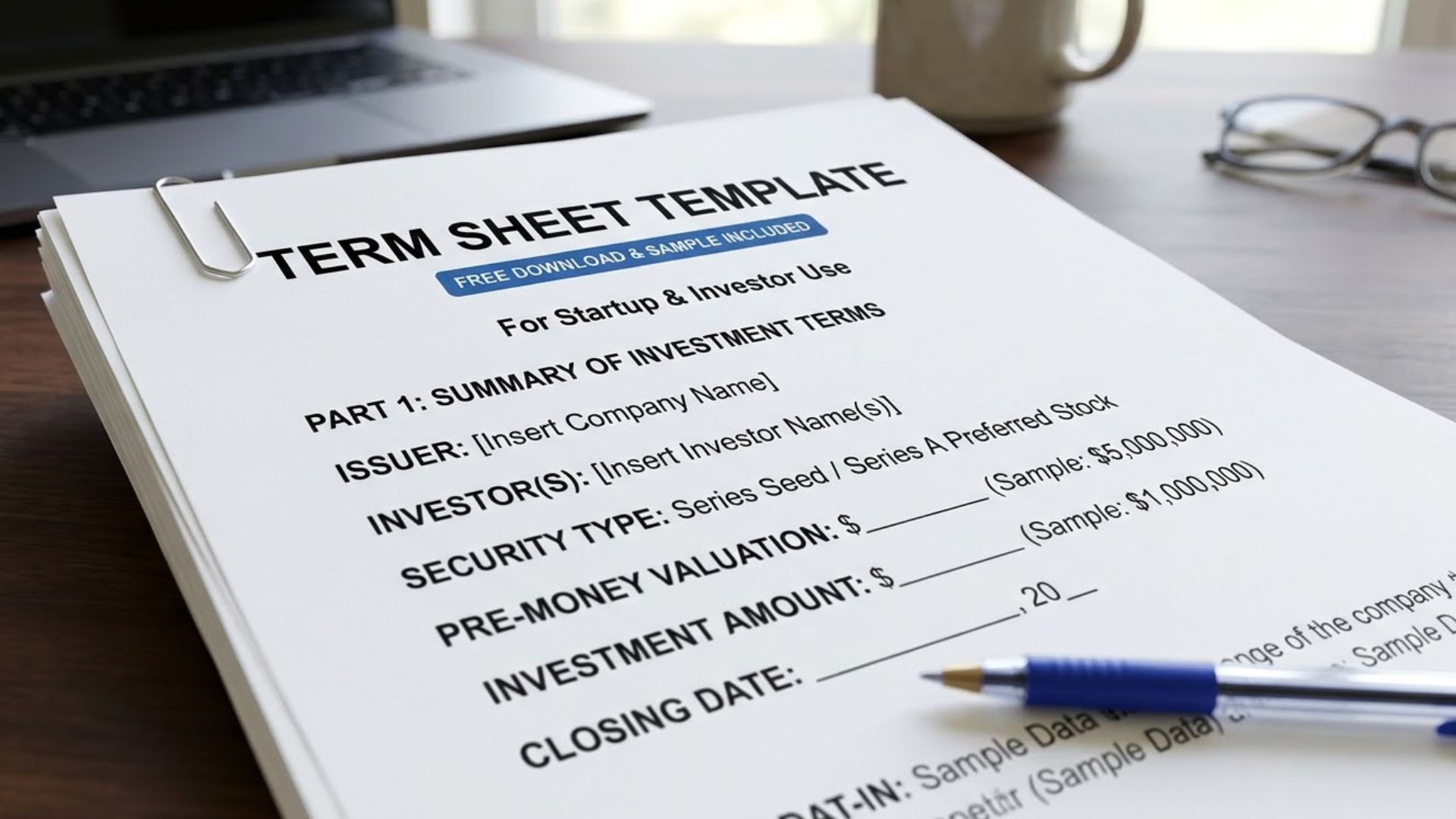
Sooner or later, a founder opens an email with “Term Sheet” in the subject line, reads the first page, and wonders whether any of it is normal. A term sheet template answers that question. It lists the key terms of an investment, such as valuation, amount, liquidation preference, board seats, and investor rights, on one or two pages, so you can see what a standard deal looks like before you look at yours.
Below you'll find a free template you can copy, a filled-in sample for a seed round, the clauses worth reading twice, and a few practical negotiation tips. One rule applies throughout: before you sign anything, have a startup lawyer review the final version.
What Is in a Term Sheet Template?
A startup term sheet template is usually split into two parts. The first covers economics, meaning who gets what money: valuation, the amount raised, the option pool, and the liquidation preference. The second covers control, meaning who makes decisions: board composition, protective provisions (decisions that need investor approval), pro rata rights, and information rights.
Most of what a term sheet template covers isn't legally binding. It records what both sides intend, and the binding promises come later in the final investment documents. A few clauses do bind you straight away, usually confidentiality, exclusivity (often called “no-shop”), who pays legal costs, and governing law. Read those carefully, because a no-shop clause stops you from talking to other investors for 30 to 60 days. For a plain-English explanation of every clause, see our guide to term sheets explained.
Copy the term sheet template below into a document and replace the brackets with your numbers. Keep the clause names as they are, because investors and lawyers will recognize them, and delete any line that doesn't apply to your round.
TERM SHEET - SERIES SEED PREFERRED STOCK
[Company name], Inc.
Not legally binding, except for Confidentiality, No-Shop, Expenses, and Governing Law.
Economics
| Term | Template |
|---|---|
| Amount raised | $[amount] |
| Lead investor | [fund name], $[amount] |
| Pre-money valuation | $[amount] |
| Post-money valuation | $[amount] |
| Security | Series Seed Preferred Stock |
| Option pool | [X]% of the post-money fully diluted capitalization, included in the pre-money valuation |
| Liquidation preference | [1]x, [non-participating] |
| Dividends | Non-cumulative, only if declared by the board |
| Anti-dilution | [Broad-based weighted average] |
Control
| Term | Template |
|---|---|
| Board of directors | [X] seats: [X] founders, [X] investors, [X] independent |
| Protective provisions | Approval of Preferred holders required to [list] |
| Pro rata rights | Major investors may invest in future rounds to keep their ownership |
| Information rights | Annual and quarterly financial statements to Major investors |
| Founder vesting | [4] years, [1]-year cliff, [X] months credited for time served |
Other
| Term | Template |
|---|---|
| No-shop | [30] days from signing |
| Expenses | Company pays investor legal fees up to $[cap] |
| Confidentiality | Terms are confidential except to advisors |
| Governing law | [State] |
| Closing target | [date] |
Sample Term Sheet (Filled In)
Here's how a sample term sheet might look for a realistic seed round. The company, which we'll call Brightline Analytics, raises $3M from one lead fund:
- Amount and valuation: $3M at a $12M pre-money valuation, so $15M post-money. The investor owns 20% after the round.
- Option pool: 10% of post-money capitalization, created before the round, so founders absorb the dilution.
- Liquidation preference: 1x non-participating. In a sale, the investor gets either their $3M back or their 20% share, whichever is larger.
- Anti-dilution: broad-based weighted average, which adjusts the investor's price moderately if a later round is priced lower.
- Board: three seats, two founders and one investor.
- Protective provisions: investor approval needed to sell the company, issue new senior shares, or change investor rights.
- Pro rata and information rights: standard, for investors putting in at least $500K.
- Founder vesting: four years with a one-year cliff, with 12 months credited for time already worked.
Almost everything in this sample term sheet is standard for a US seed round in 2026. It also shows why reading terms together matters: the $12M valuation looks fine on its own, but the pre-money option pool means the founders' effective valuation is closer to $10.5M. Where it can turn aggressive: a 2x or participating liquidation preference, full-ratchet anti-dilution, an option pool of 15-20% placed entirely in the pre-money, or a board where investors hold a majority at seed.
A seed term sheet is usually lighter than a Series A one. There may be no investor board seat at all, fewer protective provisions, and simpler documents. At Series A, expect a five-person board, longer lists of investor approvals and much more detailed due diligence.
Term Sheet Example: Clauses to Watch
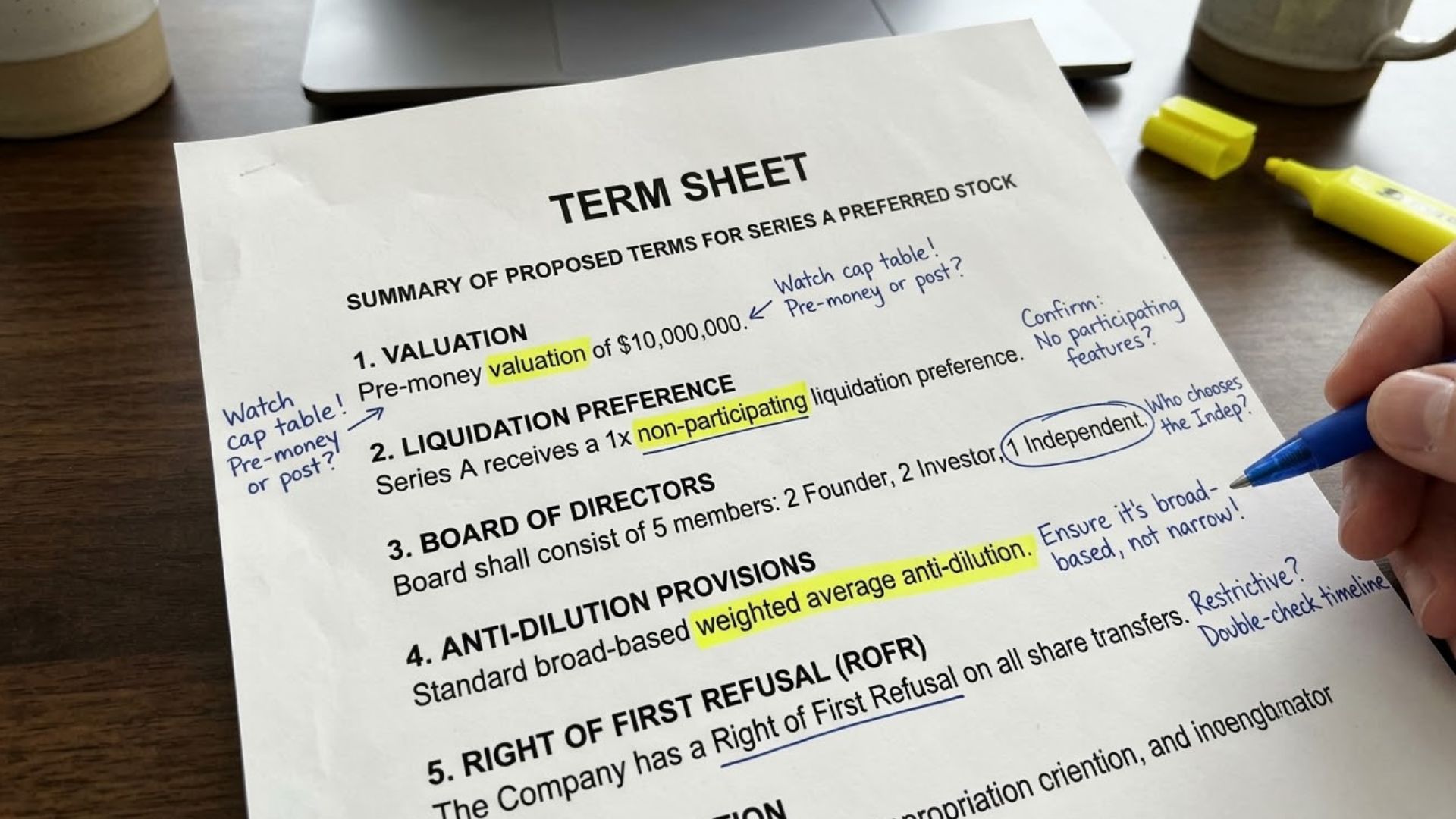
Every term sheet example has a handful of clauses that move the outcome far more than the rest. These are worth reading twice:
- Liquidation preference. Founder-friendly: 1x non-participating. Investor-friendly: 2x, or participating, where the investor takes their money back and then also shares in the rest. Tip: hold firm on 1x non-participating at seed. It's the market norm, and most good investors accept it without a fight.
- Participation. Founder-friendly: none. Investor-friendly: full participation. Tip: if you can't avoid it, ask for a cap; for example, participation stops once the investor has received 3x their money.
- Anti-dilution. Founder-friendly: broad-based weighted average. Investor-friendly: full ratchet, which reprices the investor's shares to the lowest later price. Tip: treat full ratchet as a red flag and push back.
- Option pool. Founder-friendly: sized to a real hiring plan, often 10%. Investor-friendly: a large option pool, all in the pre-money. Tip: bring a hiring plan for the next 18 months to justify a smaller pool.
- Board composition. Founder-friendly: founders keep a majority. Investor-friendly: investors control the board. Tip: at seed, a two-founder, one-investor board is normal, so ask for it.
Read any term sheet example with a pencil and mark every clause that differs from the founder-friendly version. That list becomes your negotiation agenda. It also keeps the conversation focused: most investors respond better to two or three well-argued requests than to a redline on every clause, so lead with what matters most to you, usually the liquidation preference and the board.
How to Use This Template
There are three good ways to use this term sheet template. As a reference, so you know what a standard offer looks like before one arrives. As a comparison tool: put two or three offers side by side, clause by clause, in the same startup term sheet template; a higher valuation with a 2x preference can be worth less to you than a lower one with clean terms. And as a starting point to set your expectations before negotiating with a lead investor.
Before you sign anything, model each term sheet example you receive on your cap table. Put the new shares, the option pool, and any SAFEs that convert in this round into one spreadsheet, and check what you'll own after closing and what you'd receive in a few sale scenarios. Founders are often surprised by how much a pre-money option pool or stacked SAFEs change the result. Our equity dilution calculator gives a quick first check.
Finally, have a startup lawyer review the final version. Many will review a seed term sheet template or a live offer for a fixed fee, which is far cheaper than fixing a bad term later. A good template helps you understand the deal. It can't replace advice on your specific situation.
Frequently Asked Questions
What is a term sheet?
A term sheet is a short document, usually one or two pages, that sets out the key terms of an investment: amount, valuation, liquidation preference, board seats, and investor rights. It's mostly non-binding and serves as the basis for the final legal documents signed at closing.
Is a term sheet legally binding?
Mostly no. The economic and control terms are statements of intent until the final documents are signed. A few clauses usually bind both sides immediately, typically confidentiality, exclusivity or no-shop, who pays legal expenses, and governing law. Breaking those can have real legal consequences.
What should a seed term sheet include?
A seed term sheet should include the amount raised, pre-money valuation, option pool size, liquidation preference, board composition, and investor rights such as pro rata, information rights, and protective provisions. It should also cover founder vesting, the no-shop period, and who pays legal fees.
Who drafts the term sheet?
The lead investor usually drafts the term sheet and sends it to the founders, often based on the fund's standard template. Founders then negotiate the terms with help from a startup lawyer. Other investors in the round normally accept the terms agreed with the lead.
Be Ready for the Term Sheet, With solvee
Most founders see their first term sheet and accept the defaults. They don't know which terms are standard, they haven't modeled the numbers, and they're worried that pushing back will cost them the deal. A term sheet template helps, but your negotiating position is decided earlier: by how well you know your business, your metrics, and what you need the money for.
solvee is a personalized AI accelerator that helps founders get investment-ready before that email arrives. It works through the foundations investors look at, from customer and solution to market and traction, scores where you stand and shows the gaps to close first. Its advisor knows your strategy and your numbers, so you can ask how much you really need to raise and which milestones the round should fund, and walk into negotiations with clear answers.
See how solvee works and start free, no credit card required, so the first term sheet you receive finds you prepared.