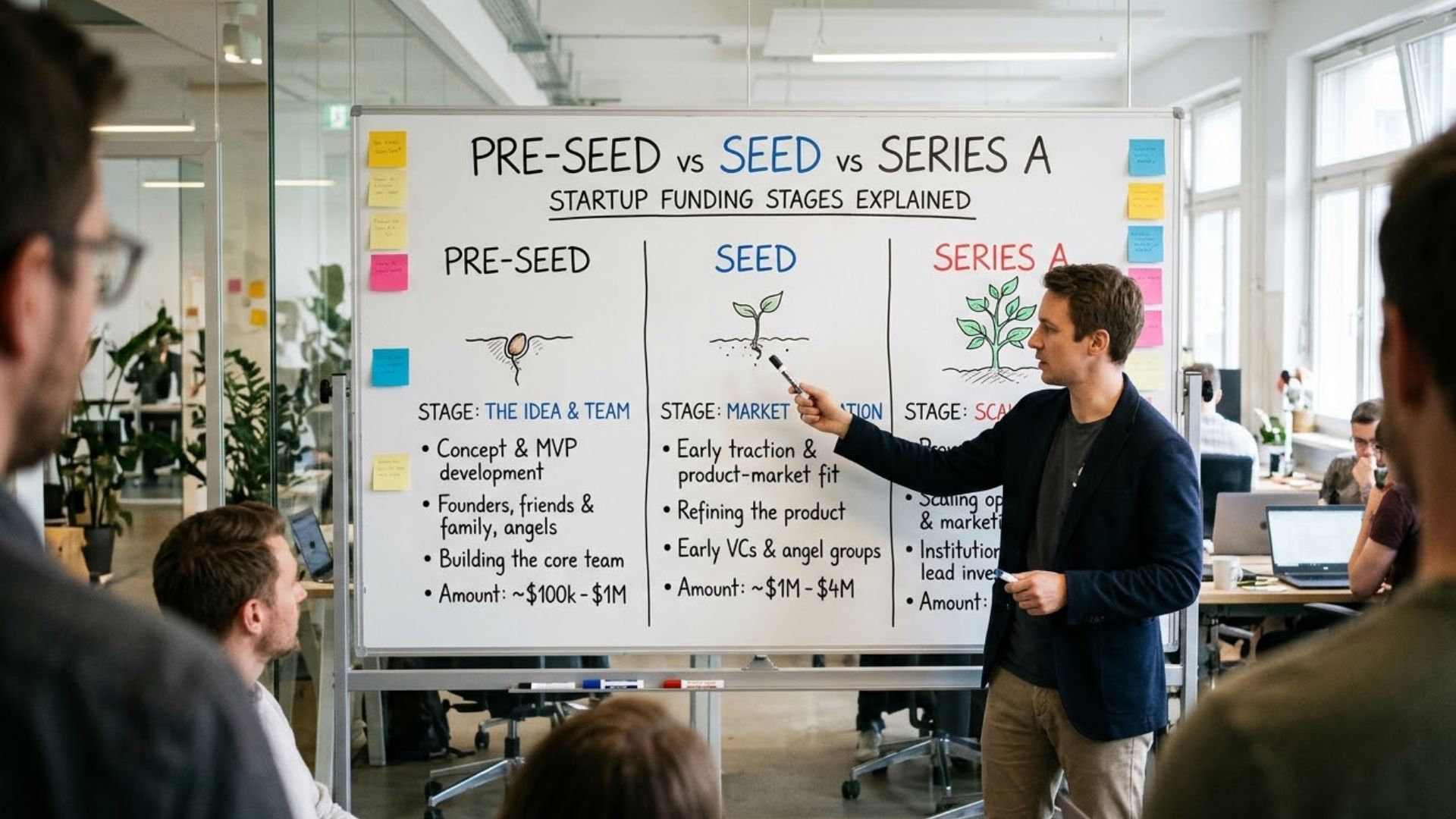
Pre-seed, seed, seed-plus, seed extension, Series A. Ask five investors where one ends and the next begins, and you’ll get five slightly different answers; the lines have also shifted over the past few years as rounds have gotten bigger. The basic logic hasn’t changed, though. Startup funding stages follow the company’s progress: pre-seed backs an idea and a team, seed backs early traction, and Series A backs a growth engine that already works and needs fuel.
Today, we’ll go through the startup funding stages one by one: what each stage means, typical round sizes in 2026, what investors expect at each one, and a quick way to tell which stage you’re actually in. Keep one thing in mind as you read. The label on your round matters much less than the milestones behind it, and investors judge you on the milestones.
The Stages of Startup Funding at a Glance
Most companies move through the stages of startup funding in roughly this order: bootstrapping with the founders’ own money (sometimes with help from friends and family), then pre-seed, seed and Series A, followed by Series B, C and later growth rounds. Plenty of good companies skip a stage, and some never raise at all.
| Stage | Typical round size | Typical investors | Milestones investors expect |
|---|---|---|---|
| Pre-seed | $250K-$1.5M | Angels, pre-seed funds, accelerators | Strong team, clear problem, prototype or first users |
| Seed | $2M-$5M (larger in AI) | Seed funds, angel syndicates | Working product, early revenue or engaged users, signs of demand |
| Series A | $7M-$20M | Venture capital firms | Repeatable growth, solid unit economics, a channel that scales |
| Series B and later | $20M+ | Growth-stage VCs | Proven model, expanding into new markets or products |
These ranges are based on Carta data for 2026: the median software seed round raised about $4.1M and the median Series A about $14.4M. A small number of very large AI rounds pull the averages up, so most founders will see numbers toward the lower end.
The table also shows why amount alone doesn’t define startup funding stages. A $3M round can be a big pre-seed for an AI team with a famous founder or a modest seed for a consumer app. Investors look at progress: what you’ve proven and what the money will help you prove next.
Pre-Seed vs Seed: What Is the Difference?
The simplest way to frame pre-seed vs seed is this: pre-seed funds the team and the idea; seed funds early evidence that the idea works. At pre-seed, you might have a deck, a prototype, and a handful of beta users. By the time you raise a seed round, you should have a product people use and some numbers that show they care, whether that’s revenue, retention, or a waitlist that converts.
The investors and paperwork differ too. Pre-seed money usually comes from angels, small specialist funds, and accelerators, and almost always on a SAFE, so nobody has to agree on a price yet. A seed round is bigger and often led by an institutional seed fund. It may still use SAFEs, but priced rounds with preferred stock are more common here, especially when a lead investor writes a large check.
What should the money achieve? A seed round should take you from “people want this” to “we know how to find more of these customers.” In practice, that means hiring a few key people, tightening the product, and finding at least one acquisition channel that works reliably. Founders often confuse pre-seed vs seed because both are early, but the investor’s question changes: at pre-seed it’s “can this team build it?”, at seed it’s “will the market pull it?”
When it comes to pre-seed vs seed, you’re probably ready to move up when:
- The product is live and used by real customers, not only testers.
- You have early revenue, strong engagement, or retention you can show in a chart.
- You can explain who buys, why they buy, and roughly what it costs you to win them.
- You can name the milestones the next 18-24 months of funding will reach.
Seed vs Series A: What Changes

The seed vs Series A jump is about proof. Seed money is raised on proof of demand. Series A money is raised on proof that you can turn demand into growth again and again, with a sales or marketing engine that works when you put more money into it.
That shifts what investors examine. Series A funding investors want revenue, often around $1M-$3M in annual recurring revenue for software companies, though the bar varies by sector and by year. They want consistent growth, healthy retention, and a team that can run a bigger company. Above all, they look closely at unit economics: how much it costs to acquire a customer, how much that customer is worth, and how long it takes to earn the cost back.
The process changes as well. Series A is almost always a priced round with preferred stock, a lead investor, and a negotiated term sheet. The lead usually takes a board seat. Due diligence goes much deeper, covering your financials, cap table, contracts, and customer data. Founders who get from seed to Series A smoothly tend to have their data room in order months before they start talking to investors.
Series A funding also tends to take longer to close. Three to six months from first meeting to money in the bank is common, so planning your runway around that matters.
How to Know Which Stage You Are In
To place yourself among the startup funding stages, do a quick self-check on five points: team, product, users, revenue, and growth. If you have a team and a clear problem but no real product yet, you’re at pre-seed. A live product with paying or highly engaged users points to seed. Steady revenue that grows month after month, with numbers you can explain, puts you in Series A territory.
The pre-seed vs seed question gets especially tricky for founders with a product but very little usage. In that case, you’re still pre-seed in most investors’ eyes, whatever the round is called.
Raising for the wrong stage is costly. Pitch Series A metrics with seed numbers and investors will pass quickly. Pitch too early as a seed round, and you’ll spend months in meetings that don’t convert while your cash shrinks. The fix is to work backward from the next round: write down what investors at the next startup funding stages will expect, then set milestones and a budget to get there with a few months to spare.
Frequently Asked Questions
What are the stages of startup funding?
The main stages are pre-seed, seed, Series A, and later rounds such as Series B and C. Each stage is tied to progress rather than a fixed amount: pre-seed funds an idea and team, seed funds early traction, and Series A funds a proven, repeatable growth engine ready to scale.
What is the difference between pre-seed and seed?
Pre-seed funds the team and the idea, often before a product is live, usually through SAFEs from angels and small funds. Seed funding requires early traction: a working product, real users, and early revenue. Seed rounds are larger, more often led by institutional funds and sometimes priced.
How much is a typical seed round?
In 2026, a typical seed round in the US is roughly $2 million to $5 million; Carta puts the median for software startups at about $4.1 million. AI startups often raise more. The median seed valuation is around $20 million, and consumer and non-AI companies usually land toward the lower end.
What do you need to raise a Series A?
You need repeatable growth, strong metrics, and a clear path to scale; for software companies, that often means $1 million to $3 million in annual recurring revenue, healthy retention, sound unit economics, and at least one acquisition channel that keeps working as you invest more.
Know Your Stage and Your Gaps, With solvee
Most fundraising problems we see start with one mismatch: founders pitch the round they want instead of the stage they’re in. A company with a prototype and a few pilot users goes out asking for a seed round, investors pass without much explanation, and the team loses months.
solvee is a personalized AI accelerator that helps founders get investment-ready for their next round. It works through the foundations investors check at every one of the startup funding stages, from customer and solution to market and traction, and shows which gaps to close first.
A good place to start is the free Investor Readiness Score. Upload your pitch deck and get a score from 0 to 10 for your stage, the gaps investors would question, and a step-by-step plan to fix them. In a few minutes, you’ll know whether you’re ready for the round you have in mind, or which milestones to hit before you start pitching.