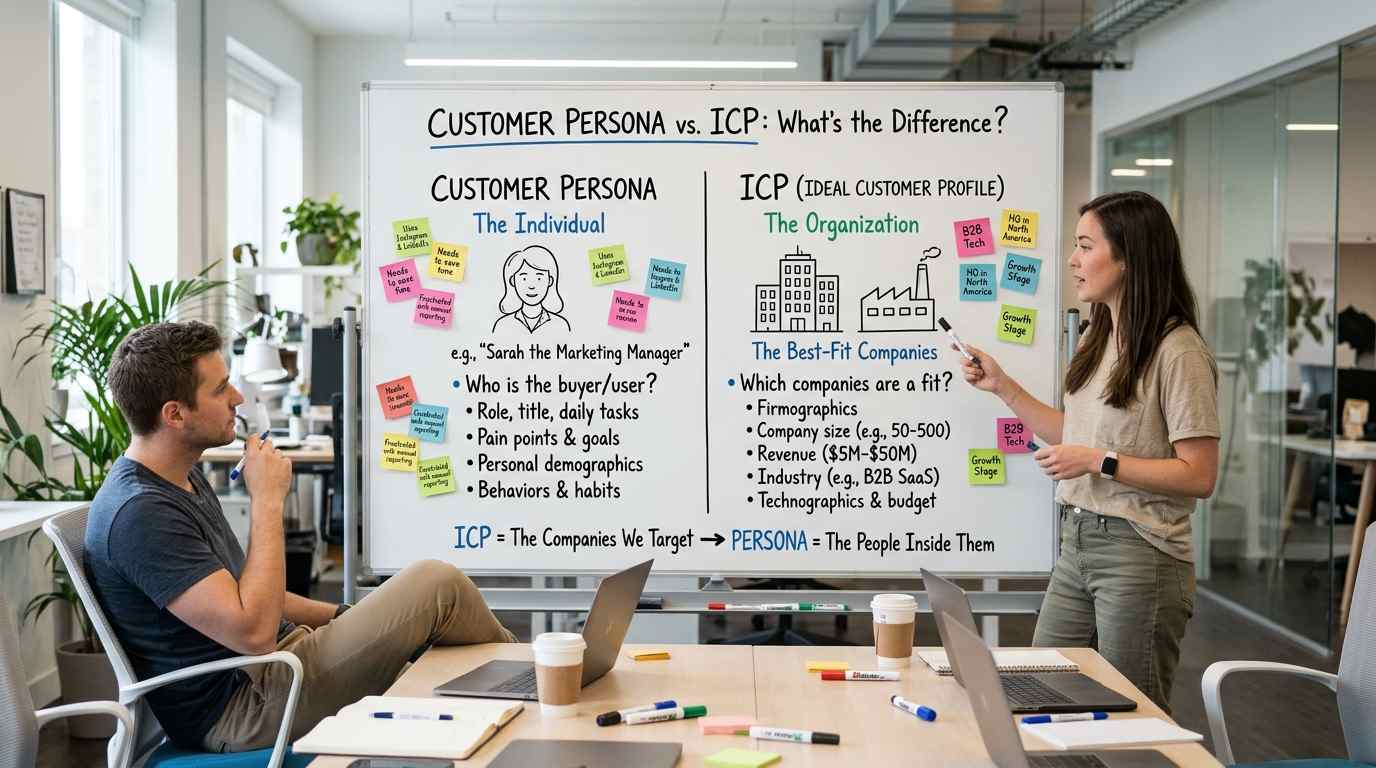
Customer persona vs.ICP: one is a company, the other is a person. Your ICP describes the type of account worth selling to. A customer persona describes the human you end up emailing, calling, or demoing to inside that account. If you sell to businesses, you’ll need both, and most early teams have only one.
Founders hear these two terms in every second marketing meeting and nod along. Ask them to explain the difference, though, and the answers quickly become blurry. In practice, that fuzziness shows up as an ad budget spent on clicks from companies that were never going to buy, or a cold email sequence where the open rate looks fine and nobody writes back.
What Is an Ideal Customer Profile (ICP)?
An ideal customer profile describes the company you most want as a customer. It doesn’t include individual people. Think of it as a filter for accounts: which businesses are most likely to buy from you soon, stick around for years, and get real value out of the product?
The ICP earns its keep in three places. Targeting, because it tells marketing which lists to build. Lead qualification, because a rep can rule an account out in two minutes instead of after three calls. And focus, which is harder to measure but probably matters most. Without a written ICP, sales teams tend to chase whoever replies, and in B2B that’s a slow way to burn the runway.
A typical ICP covers these firmographic details:
- Company size and employee headcount
- Annual revenue and funding stage
- Industry and market niche
- Geographic location and time zone
- The core business problem they face today
A quick example. Suppose you sell shift-scheduling software. Your ideal customer profile could be a UK retail chain with 200 to 500 staff that opened five new stores in the past year and is losing people faster than it can hire them. Hand that description to a sales rep and they know exactly which companies to look up on LinkedIn tomorrow morning.
What Is a Customer Persona?
A customer persona is about the human side of the deal. It’s a semi-fictional sketch of one decision-maker, built from interviews rather than imagination (more on that below). If the ICP is the building, the persona is whoever sits at the desk on the third floor and decides whether your email gets a reply. A logo has ever sold nobody.
Good personas usually include:
- Job title and daily tasks
- Career goals and personal motivations
- Daily frustrations and sources of stress
- Common objections to buying new tools
- Where they spend their attention online
It also helps to separate the user from the buyer persona. In many B2B products, the user is someone fairly junior who lives in your app all day. The buyer sits a level or two higher and signs off on the budget. Occasionally it’s one person wearing both hats. More often it isn’t, and the user wants an easier Tuesday while the buyer wants a number to show the board.
Take “Marketing Director Dave,” who works at a mid-sized tech agency. Every Thursday evening he copies numbers from four tools into a spreadsheet for the Friday leadership meeting, and he hates it. What he wants most is to walk into that meeting looking like he has everything under control. A good customer persona for Dave tells you how to pitch him: talk about getting his Thursday evenings back and a report his CEO actually reads. The integrations list can wait for the demo.
Customer Persona vs.ICP: the Real Difference
The rule of thumb for customer persona vs.ICP is easy to remember. The ICP picks the account; the persona picks the words. Or, if you prefer the building metaphor, the ICP is the office, and the persona is the person holding the keys.
In a working funnel, you use them in sequence. Marketing starts with the ICP to pull a list of, say, 500 companies that fit, and throws out the rest. Only then do personas come in, shaping the subject lines, the landing page copy, and the first two sentences of each email around problems those people actually have.
An HR software company makes a good B2B example. Account side: tech startups with around 50 employees that closed a Series A in the last six months. Person side: the newly hired Head of HR at one of those startups, who has 20 people starting next month and an onboarding process that lives in a Google Doc. The ICP finds the company. The persona is why the email to her opens with onboarding instead of “all-in-one HR platform.”
B2C changes the balance. When you sell to consumers, there’s no company to qualify, so the persona does nearly all the work, and the details that matter shift towards habits, budgets, and what pushes someone to buy on a given day.
Mixing the two up costs real money, and the mistakes are oddly specific. Some teams write a sharp, well-researched email and send it to companies that are far too small to afford them. Others build a perfect account list and then send everyone the same generic pitch, usually addressed to the CEO, who forwards it nowhere. When people ask us about customer persona vs.ICP, this is usually the problem behind the question.
How to Create a Customer Persona

Most weak personas are written in a meeting room. Someone says, “Our buyer is probably a busy manager who values efficiency,” everyone agrees, and that becomes the persona. If you’re wondering how to create a customer persona that sales will actually use, the honest answer is phone calls.
Start with five or six of your best current customers. Ask for 15 minutes, and promise you won’t pitch anything. Then ask them to walk you through a normal Tuesday. Ask what happened right before they started looking for a tool like yours, the day they decided to buy, and what nearly made them walk away before signing. That last question tends to produce the most useful answers.
Write down their exact phrases. If a customer says “I was drowning in spreadsheets,” keep that, and resist turning it into “operational inefficiency” in your notes. A big part of how to create a customer persona well is protecting the customer’s own words, because those words end up in your headlines later. By the fourth or fifth call, you’ll notice people describing the same frustrations in almost the same language.
Then hand the draft to whoever talks to prospects most and ask one question: does this sound like the people you actually speak to? Adjust whatever they push back on. Plan to revisit each customer persona every few months, or sooner after a big product change, since the people you sell to will change as the market does.
One last check: confirm that the people you interviewed work at companies matching your ideal customer profile. A persona built from interviews with poor-fit accounts will point your messaging at the wrong crowd, no matter how accurate it is.
Frequently Asked Questions
What is the difference between a customer persona and an ICP? An ICP describes the type of company you want to sell to. A persona describes the individual you talk to inside that company. Use the ICP to choose accounts and the persona to decide what to say to them.
What is an ideal customer profile? An ideal customer profile describes the best-fit account for your product, based on firmographic details like company size, industry, growth stage, and the business problem they’re dealing with. It keeps sales focused on accounts that are likely to buy.
What is a customer persona? A customer persona is a semi-fictional profile of an individual buyer or user: their role, goals, frustrations, and typical objections. It helps you write marketing and emails that sound like they’re meant for a specific person.
Do you need both an ICP and a persona? Yes, if you sell to businesses. Answering customer persona vs. ICP isn’t really about picking one. The ICP tells you which accounts to go after, and the persona tells you how to talk to the people inside them.
Target the Right Buyer, With solvee
Building both profiles from scratch takes time most founders don’t think they have. So they skip it, target “SMBs” or “marketing teams,” and spend a few months of runway learning the hard way who doesn’t buy. We see this pattern constantly at the early stage.
solvee is a personalized AI accelerator, and defining the customer is where it starts with every founder. The guided program begins with your ideal customer profile and the people inside those accounts, then moves to market, value proposition, and positioning. Each step is checked against real customer conversations, not assumptions. You get a score for how clearly you define your customer, along with the specific gaps to close.
solvee also helps you prepare for customer calls and reviews them afterward, so the phrases people use end up in your persona instead of in a notebook you never reopen. And since the advisor already knows your strategy, you can ask something like “which buyer persona should I go after first?” and get an answer about your business.
See how solvee works and start free, no credit card needed. The free plan covers the foundation assessment and your first few call reviews, which is enough to turn next week’s customer interviews into a persona your team will use.