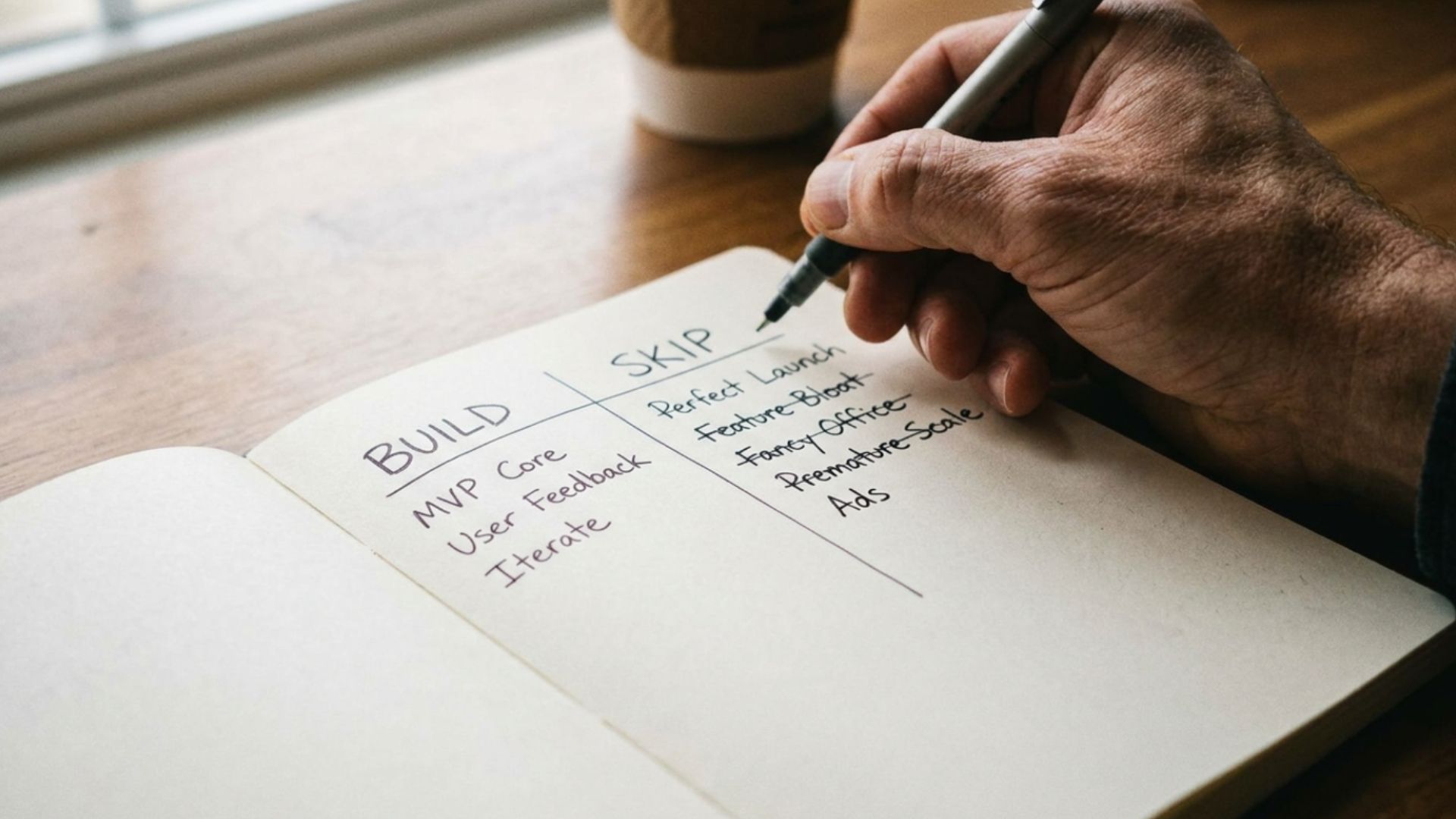
Most founders don't fail because their idea was bad. They can fail because they spent eight months building version one, ran out of money three weeks after launch, and never learned whether anyone wanted it. Bad MVP development looks exactly like that: you pour your runway into a bloated first release, polish features nobody asked for, and by launch there's no budget left to fix what's wrong.
The MVP meaning is the smallest thing you can put in front of real users to test your riskiest assumption. Not a smaller version of your full product. A test.
Our article covers what a minimum viable product actually is, the different types of MVP, how to scope one, real examples, and the mistakes that burn through founders' budgets. MVP development done right isn't about shipping something tiny for its own sake. It's about learning fast, before the money runs out.
What an MVP Actually Is
People constantly misread the MVP meaning, and that misreading costs money. A minimum viable product is not a cheap, half-working version of your real idea. It's a tool built specifically to learn something about your market, as fast and cheaply as possible.
Break the phrase down. "Minimum" means you build only what's needed to run the test, nothing extra. "Viable" doesn't mean functional or bug-free. It means the thing delivers enough real value that a user's response actually tells you something true. A landing page with a fake button teaches you nothing about willingness to pay. A landing page with a working payment link, even a manual one, does. That gap between "looks finished" and "actually proves something" is what the MVP meaning comes down to in practice.
A minimum viable product also isn't one specific format. It's a method: test the assumption, skip everything else. The same idea takes different shapes depending on what you're trying to learn, which is where the types come in.
Types of MVP
There's no single correct format for MVP development. The right one depends on which assumption you're testing. Four show up most often:
- Landing page MVP: tests demand before anything exists. You write the pitch, add a signup or pre-order button, and drive some traffic to it. If nobody clicks, you just saved yourself months of building.
- Concierge MVP: delivers the service manually, by hand, before any of it is automated. If you're building a meal-planning app, you personally plan meals for ten users over email first. It's slow, and it doesn't scale, but it tells you whether people want the outcome badly enough to pay, before you write a line of code.
- Wizard-of-oz MVP: looks automated from the user's side but runs on manual work behind the scenes. The user sees software; you're doing the task yourself, watching for where it breaks.
- Single-feature MVP: strips a bigger vision down to the one function that matters most, and ships only that.
Each type answers a different question. Landing pages test interest. A concierge MVP tests willingness to pay. Wizard-of-oz tests the actual workflow before you automate it. Single-feature tests whether your core function holds up in daily use.
A few well-known companies started this way. Airbnb's founders rented out air mattresses in their own apartment before any platform existed. Zappos' founder photographed shoes from a local store and bought them himself the moment someone ordered, just to see if people would buy shoes online at all. Neither one built the "real" product first, and neither needed a big budget to find out if the idea held up. Founders using solvee get pushed through the same discipline early on: name the one thing you need to test before you touch a feature list.
How to Scope Your MVP
How to build an MVP starts with one sentence, not a spec document. Name your core assumption first: the one thing that, if wrong, sinks the whole business. Build everything to test that one thing.
Once that sentence is written, run every feature idea through a simple filter:
- Must-have: directly tests the core assumption.
- Nice-to-have: just makes the product feel more finished.
Cut every nice-to-have. Not later. Now. That filter is, in practice, how to build an MVP without accidentally rebuilding your whole product plan.
This is also where founders mix up two different things, and getting MVP vs prototype wrong wastes time. A prototype demonstrates that something can technically work, usually for internal review or a pitch. It doesn't need real users or real money changing hands. An MVP tests whether people actually want it, using real signups, payments, and repeat use as evidence.
The rule that keeps scope honest: if a feature doesn't directly test your core risk, it waits.
MVP Examples That Worked

A few concrete MVP examples make the whole idea easier to apply to your own product:
- Dropbox didn't build the actual syncing software first. The founder made a short demo video showing how the product would work and posted it online. The waitlist that formed overnight was the real evidence, gathered before a single line of the sync engine existed.
- Buffer started as a two-page site: one page explaining the idea, a second asking people to pick a pricing plan. No software behind it yet. The founder was testing whether people would commit to paying, not whether the tool worked.
- Airbnb fits the MVP vs prototype distinction too: air mattresses on a real apartment floor is about as far from a polished prototype as you can get. It was a real transaction with real strangers and real money, not a demo of a vision.
What ties these together: each one tested a single, specific question, and each one skipped building anything the test didn't require. Dropbox skipped the sync engine. Buffer skipped the scheduling backend. Airbnb skipped the platform entirely. Good MVP development looks like that in practice, not moving fast for its own sake, but refusing to build ahead of the evidence.
Common MVP Mistakes
The same handful of mistakes show up across most failed MVP development attempts:
- Building too big. "Minimum" quietly becomes "everything I think a real product needs," and the test balloons into a six-month project.
- No clear hypothesis. If you can't finish the sentence "this MVP will tell me whether …," you have a guess wearing a build plan.
- Shipping and not measuring. Founders launch, feel relieved, and forget whether the core assumption held up.
A bloated result of poor MVP development does more damage than wasted time alone. It burns the runway you needed for round two and round three, and delays the moment you learn whether the idea works.
A short checklist before you build:
- Write the core assumption in one sentence.
- List only the must-have features that test it.
- Decide in advance what counts as a pass or a fail.
If you can't answer all three, you're not ready to build yet. An MVP tests one assumption. How many of these tests you actually get to run comes down to something separate: your runway and how carefully you spend it.
Frequently Asked Questions
What does MVP mean? MVP stands for minimum viable product: the smallest version of a product built to test a core assumption with real users, not a stripped-down draft of the final vision.
What are the types of MVP? The main types of MVP are the landing page, concierge MVP, wizard-of-oz MVP, and single-feature MVP. Each tests a different assumption, from demand to willingness to pay to whether the workflow holds up.
How do you build an MVP? Name your core assumption in one sentence, then build only the features that directly test it. Cut or park anything that doesn't test that risk.
What is the difference between an MVP and a prototype? A prototype shows that an idea can technically work, usually for internal review. An MVP tests demand, using real user behavior like signups or payments as evidence.
Build the Right First Version, With solvee
Naming your core risk, and having the discipline to cut everything that doesn't test it, is where most MVP development attempts stall out. solvee, a personalized AI accelerator, closes that gap.
solvee works through your business context to help you name the real assumption behind your idea, not the comfortable one, then helps you cut the feature list down to only what tests it. Instead of a blank prompt where you already have to know what to ask, the product walks you through the questions in order and keeps your reasoning consistent from one session to the next.
Most first launches don't sink because of a bad idea. They sink because founders build features instead of building tests, and nobody stopped to separate the two. solvee handles that separation before you write a single line of code.
If you're staring at a feature list and not sure what belongs in version one, settle that before you build anything.
Get free access to solvee - no credit card, no equity, start today.