
At the earliest stage, startup fundraising works by delaying valuation until your company grows. A SAFE note makes this possible by letting an investor give you money now in exchange for company stock later, usually when you raise your first priced round.
Raising money for a brand-new startup can feel confusing. With no sales and few users, how can you tell an investor what your company is worth? If you price too high, you might fail to hit it later. If you guess too low, you give away too much of your company too early.
That is the problem SAFE solves. If you're wondering what a SAFE note is and whether you should use one, below you'll see how it works, how a valuation cap and a discount rate reward early investors, and when this contract fits your round.
What Is a SAFE Note?
SAFE stands for Simple Agreement for Future Equity. In everyday terms, it is a short contract between you and an early investor. The investor hands you cash today. In return, you promise to give them shares of company stock in the future. To understand what a SAFE note is, think of it like a gift card for stock.
When you buy a gift card at a coffee shop, you pay right away and get your coffee on a later visit. A SAFE works the same way. The investor puts in cash now. They wait to receive their real shares until you raise a formal funding round down the road.
Before this contract existed, founders mostly used a convertible note. That older document was actually a loan. It acted like bank debt. It had a calendar deadline called a maturity date, and it charged interest. If you ran out of time before raising your next round, the lender could legally ask for all their cash back. That pushed some young startups into serious trouble. A SAFE removes that risk: it carries no interest, has no repayment deadline, and doesn't sit on your books as debt.
Y Combinator introduced this document in late 2013. Founders were paying lawyers thousands of dollars just to take small checks from friends and angels. In 2018, it released the post-money version, which makes it easier to see exactly how much of the company each investor will own. Today, SAFE notes are the standard way early startups collect their very first checks.
Valuation Cap and Discount Rate
Early investors take a big gamble on you, since most young companies never make it, so they want a reward if yours becomes a hit. To give them that upside, the agreement usually includes a valuation cap, a discount rate, or both.
A valuation cap is the most important term. It sets the maximum company value used to calculate how many shares the investor gets later. Think of it as a price ceiling that protects the investor.
Here is a simple example. An angel investor gives you $100,000 today, and you set a $5 million cap. Two years later, your app is a hit, and a venture capital firm invests at a $10 million valuation. New investors buy shares based on that $10 million price. Your early angel, though, converts their money as if the company were worth only $5 million. Because of the cap, the angel gets twice as many shares per dollar as the new venture firm.
A discount rate works like a store coupon. It gives the early backer a percentage off the future share price, usually between 10% and 20%. Say a big fund agrees to buy shares at $1.00 each, and your early agreement includes a 20% discount. Your early investor pays only $0.80 per share, so their money buys more shares than new money coming into the round.
Agreements typically come in four flavors:
Cap only. The investor converts at the cap or the new price, whichever gives them more shares.
Discount only. The investor gets the percentage discount, no matter how high the company value climbs.
Cap and discount. The investor gets whichever math gives them the cheaper share price.
No cap and no discount. The investor pays the same share price as the new lead investor. This is rare and mostly used with friends and family.
Most founders and angels agree on a SAFE note with only a cap. It keeps the math clear for everyone.
SAFE vs Convertible Note
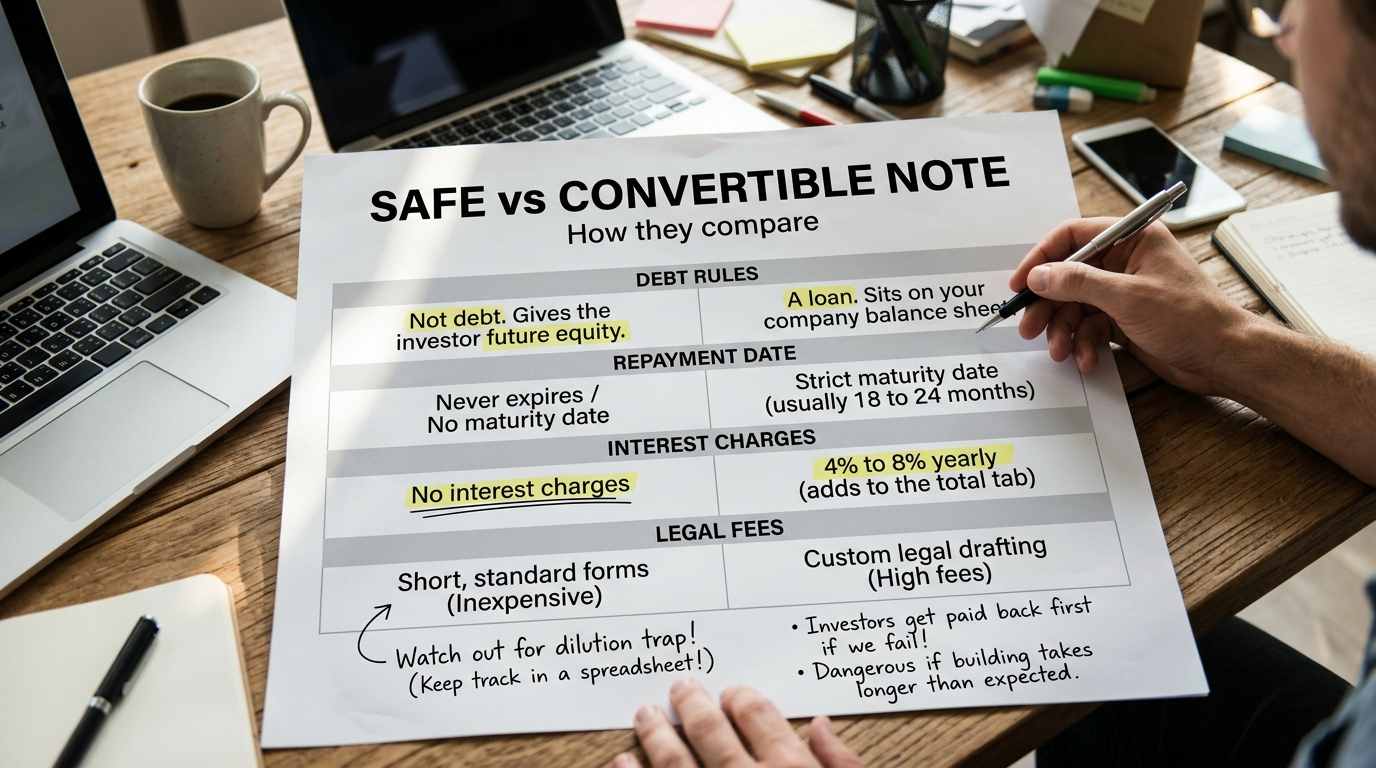
Both of these documents delay setting a hard price on your company, but they work very differently under the hood. A SAFE note gives the investor a right to future equity. A convertible note is a legal loan. Here is a side-by-side look at how they compare:
Debt rules. A SAFE is not debt. A convertible note is a loan that sits on your company balance sheet.
Repayment date. SAFEs have no maturity date. A debt note usually matures in 18 to 24 months.
Interest charges. SAFEs do not charge interest. A debt note accrues interest every year, often between 2% and 8%, which converts into extra shares later.
Legal fees. SAFEs use short, standard forms. Debt notes often need more custom drafting and cost more in legal fees.
Why does anyone still pick a convertible note today? Some older angel groups and traditional funds still prefer them. They like holding debt because lenders get paid back before shareholders if a startup fails and sells its assets.
Even so, most modern founders pick SAFE notes. A fixed maturity date is risky for a new business. If building your product takes six months longer than expected, a debt holder can demand repayment before you're ready. A SAFE removes that fear so you can stay focused on your customers.
Still, you must watch out for one big trap. Because signing SAFE notes is quick and easy, founders often take checks from ten or twenty different angels over a year. If you do not track each check in a spreadsheet, you might give away 30% or 40% of your company without realizing it. The dilution shows up all at once when the priced round finally closes. Before you sign each new check, run the numbers through the free startup calculators, which include a dilution calculator built for exactly this.
When a SAFE Note Fits (and When It Doesn't)
A SAFE note works best when your startup is young, fast, and asset-light. It is a good fit when:
You're raising smaller checks, roughly between $10,000 and $250,000.
You're raising money from friends, family, and angel investors.
You don't have steady revenue yet to justify a firm company value.
You want to close checks one by one instead of waiting for one big group close.
This speed makes the SAFE the backbone of most pre-seed funding rounds, and pre-seed funding is exactly where it shines. You do not need to hire two law firms to negotiate for weeks. You can meet an angel on Tuesday, send the standard contract on Wednesday, receive the money on Friday, and keep writing code.
However, this tool has limits. Look past it when you're raising a large round of $3 million or more from a venture capital firm, when the lead investor wants a seat on your board, when the investor requires special voting controls and formal stock rights, or when your company already has steady, predictable annual sales.
Big venture funds want preferred stock, an exact share count on day one, and voting power. At that stage, you move on to a priced equity round.
Remember that SAFE notes are real ownership promises. Never treat early checks as free money. Every check you deposit trades away a slice of your future business.
Frequently Asked Questions
How does an early SAFE contract work? Investors provide cash upfront that converts into equity during a future priced round, so you skip setting a valuation today. Each SAFE note spells out the cap, the discount, or both.
How does a SAFE differ from early debt? A SAFE carries no interest or repayment deadline. It converts to equity only during a priced round, while a convertible note is a loan with a maturity date and interest.
How does a price ceiling protect angels? It caps the maximum conversion valuation. If the company's value surges, angels convert at the lower cap and receive more shares.
Is this early contract good for founders? Yes, in most cases. A SAFE note saves legal costs and closes fast, though stacking too many can heavily dilute founder equity.
Raise Smarter, With solvee
Many first-time founders sign SAFE agreements without running the math. They sign short five-page contracts across many months, and at Series A they discover how much of the company they've already given away. The terms are rarely the only problem. Often the founder raised more, and more often, than the business needed, because the milestones weren't clear.
solvee is a personalized AI accelerator that helps founders get investment-ready before they start taking checks. It works through the questions investors care about, from customer and solution to market and traction, scores where you stand, and shows which gaps to fix first. Its advisor knows your strategy, so you can ask whether your milestones justify the amount you're raising and get an answer about your business.
A good first step costs nothing. Upload your pitch deck to the free Investor Readiness Score and see it the way an investor would: a score from 0 to 10 for your stage, the gaps they would question, and a step-by-step plan to fix them before your next pitch.