
Who actually owns the company, and how do you keep track as you raise funds? A cap table is the official record of every share, option, and SAFE in your startup. It shows everyone's exact ownership percentage, both today and after every option and SAFE converts into shares.
Below, we start with the basics: what this document is, how to read one without a headache, how dilution works, and how to keep it clean as the company grows.
What Is a Cap Table?
Let's define the terms first. A capitalization table is the master ledger of your startup's ownership. Think of it as a detailed scorecard that tells you who holds a piece of the pie at any given moment.
Who gets a row? Usually:
Founders.
Employees holding stock options.
Investors who bought shares.
Anyone holding a SAFE or a convertible note.
Advisors who received a small grant, since those fractions add up.
Founders often ignore the capitalization table until their first big funding round. That's a mistake. It matters from day one, even if it's just you and a single co-founder. Memories fade, and people remember past promises differently. A written record prevents ugly arguments later.
How do you actually build one? Most early-stage teams start with a basic spreadsheet. It's cheap and easy to manage. Later, they move to specialized software, usually when the math gets too messy for Excel. Both formats do the same job: they track the shares. The goal is clarity. You want to know who has voting control and who gets paid, and how much, if you sell the company.
Having a clean cap table matters. Every serious investor will ask for it, and it shows you run a tight ship. Keeping your capitalization table up to date is one of those jobs that's cheap to do now and expensive to fix later.
How to Read a Cap Table (With an Example)
A big financial spreadsheet can look intimidating. Still, knowing how to read a cap table is a basic founder skill, and you can't outsource understanding your own company. Let's walk through a simple cap table example row by row.
Imagine you and a co-founder start a business. You each take four million shares, for a total of eight million shares. As founders, your names go in the first rows, with your share counts next to them.
Then you raise some early money. An angel investor buys two million shares. You add their name below yours and list their two million shares. The company now has ten million shares in total.
Next, look at the share class. Founders usually hold common stock. Investors usually get preferred stock, which means they get their money back first if the company is sold for less than expected. It works as downside protection.
Then comes the most important column: ownership percentage. It shows what share of the company each person owns. In our scenario, the founders own 80% together, and the investor owns 20%.
| Holder | Share class | Shares | Ownership |
|---|---|---|---|
| Founder A | Common | 4,000,000 | 40% |
| Founder B | Common | 4,000,000 | 40% |
| Angel investor | Preferred | 2,000,000 | 20% |
| Total | 10,000,000 | 100% |
When looking at any cap table example, you need to know the difference between issued and fully diluted shares. Issued shares are the stock people hold today. Fully diluted shares include everything that could become stock later: unexercised employee options, SAFEs, convertible notes, and warrants. When you check your own stake, always look at the fully diluted number. It's the realistic picture, and it prevents unpleasant surprises.
Don't want to build this from scratch? Start from a simple cap table template. A pre-built spreadsheet with these columns saves hours of formatting.
How Equity Dilution Works
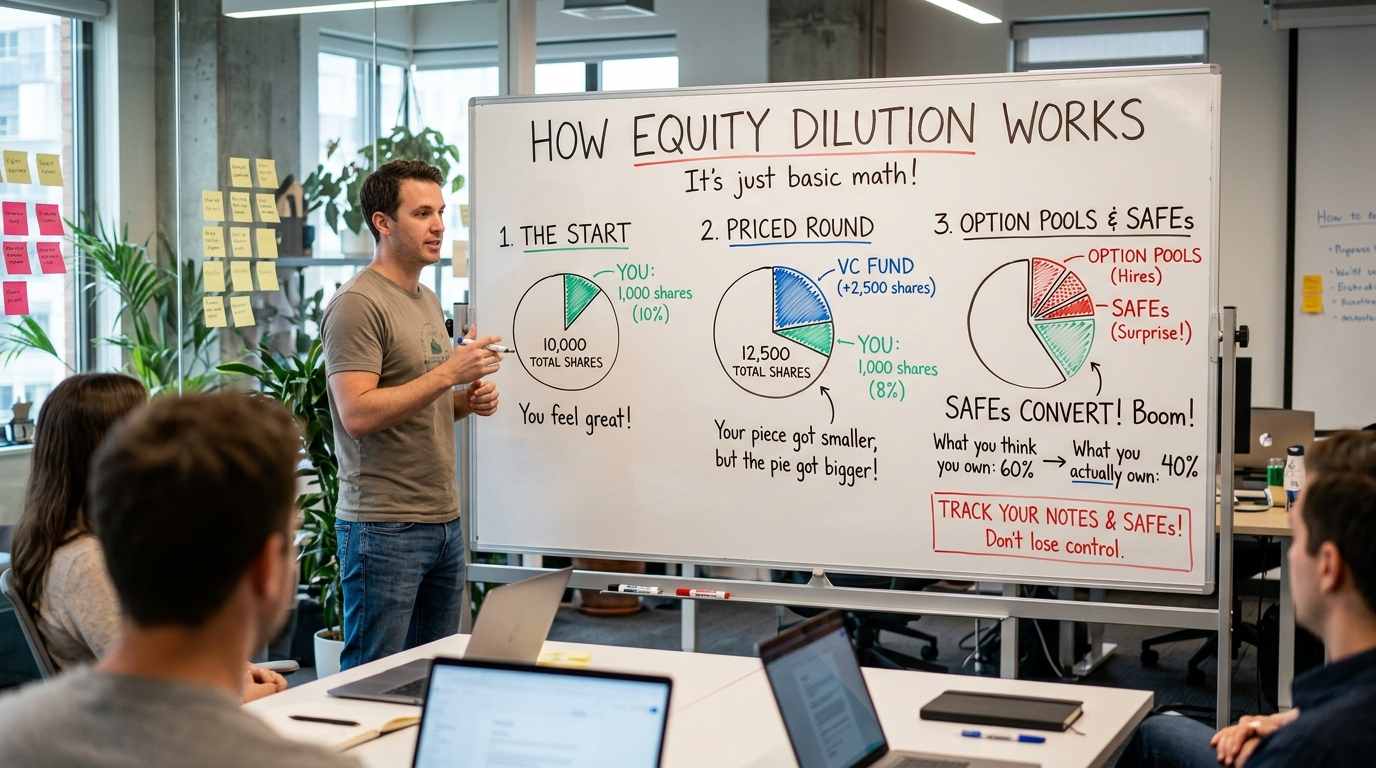
This topic scares a lot of early founders, but equity dilution comes down to basic math. It happens whenever a company issues new shares. When the total number of shares goes up, each existing owner's slice gets smaller.
Let's look at the numbers. Say you own 1,000 shares, and the company has 10,000 shares in total. You own exactly 10%.
Then you raise a priced round and sell 2,500 new shares to a venture fund. The company now has 12,500 shares. You still own your 1,000 shares, but your slice is now exactly 8%. That's equity dilution in action: your piece got smaller, while the pie got bigger. If the round raised the company's value enough, your 8% is worth more than your 10% was. Want to try it with your own numbers? The free equity dilution calculator shows how each round changes your ownership.
The same thing happens when you hire. You'll likely need an option pool to attract strong people, and creating it means setting aside new shares. Your percentage drops again. It's a trade-off most founders accept: a smaller piece of a faster-growing company.
Then there are SAFEs, which catch many founders off guard. They don't turn into shares right away. They sit on paper until a priced round. When that round happens, the SAFEs convert, and a batch of new shares appears at once. Founders who forgot about their early SAFEs think they still own 60%, then discover after conversion that they own closer to 40%. It's the most common cap table trap we see, and it's entirely avoidable. Keep every SAFE visible in your ledger, with its cap and discount, and model the conversion before you sign the next one.
Keeping Your Cap Table Clean
A messy ownership record can stall a deal. A few simple rules keep it in order:
Update immediately. Someone left the company? Update it. Signed a new SAFE this morning? Update it the same day.
Keep one source of truth. Emailing five versions of a spreadsheet back and forth guarantees errors. Use one locked, shared file.
Record the details. Note vesting schedules, grant dates, SAFE caps and discounts, and share counts.
Keep the paperwork. Every row should match a signed document: a stock purchase agreement, an option grant, or a SAFE.
Why does this matter so much? Because a messy ledger slows down fundraising. Investors run due diligence, check your math, and review option grants. If they find mistakes, they get nervous, and a forgotten SAFE can be enough to make them walk away. Lawyers also charge heavily to untangle this kind of mess. If you're getting ready to raise, our guide on how to get investors at pre-seed covers what else to have ready before the first meeting. A clean cap table is one of the easiest ways to look prepared.
Eventually, simple spreadsheets break, usually around twenty employees or when you close a Series A. The formulas get too complex. That's when dedicated cap table software makes sense, because it automates the math and handles SAFE conversions. Until then, stay disciplined. Your cap table records who owns your company, and it deserves the same care as your bank account.
Frequently Asked Questions
What is a cap table? A cap table is a ledger that tracks company ownership, including shares, options, and SAFEs, and calculates each holder's percentage.
How do you read a cap table? Look at holders, share classes, share counts, and fully diluted percentages. The fully diluted view shows true ownership after all options and SAFEs convert.
What causes equity dilution? Equity dilution happens when a company issues new shares for a funding round or an option pool. Total shares grow, so each existing owner's percentage shrinks.
Do early-stage startups need a cap table? Yes. Keeping a cap table from day one prevents legal headaches and makes due diligence much smoother when investors arrive.
Model Your Ownership, With solvee
Founders shouldn't guess their equity. Too many discover dilution late: the term sheet arrives, someone runs the math, and they realize they've given away far more than planned. The cause is rarely bad terms alone. Usually, the founder raised without clear milestones, so each new check felt urgent, and nobody added up the total.
solvee is a personalized AI accelerator that helps founders get investment-ready before they start taking money. It works through the foundations investors look at, from customer and solution to market and traction, scores where you stand and shows which gaps to fix first. Its advisor knows your strategy, so you can ask how much you really need to reach your next milestone and get an answer about your business. Raising only what the plan requires is the most reliable way to keep your stake.
When investors ask about your equity and your plan in a pitch meeting, you'll have clear answers. Start free with solvee, no credit card required, and see in a few minutes which gaps stand between you and your next round.