
A north star metric is the single number that best captures the value you deliver to customers. It keeps the whole team aligned. Many founders ask what a north star metric is when they start a new business, and the short answer is this: it’s the number that proves your product works for the people using it and predicts growth as it rises.
Most companies suffer from too many dashboards. Teams log in every morning and see dozens of charts. Marketing tracks website visitors and clicks. Sales tracks closed deals and cold calls. Product teams track feature clicks. Everyone tracks everything, yet nobody agrees on what matters most.
That creates friction inside the business. Marketing brings in cheap leads that sales can’t close. Engineers build features that marketing can’t sell. One shared number fixes a lot of this. Today, we want to cover what a north star metric is, how to choose one, real examples, and the traps to avoid.
What Is a North Star Metric?
To define the north star metric clearly, it helps to separate it from a vanity number. A vanity number looks great on a presentation slide but says little about the business’s health. Take total registered accounts. That number goes up every day, even if users dislike the software and never log in again. It’s a poor goal.
Your main metric has to pass a simple test:
- It reflects real customer value. When the number goes up, customers are getting more of what they came for.
- It predicts long-term growth. If it keeps rising, revenue and retention should follow.
One point is worth stressing. A north star metric is a leading indicator, and revenue rarely qualifies. Revenue tells you what already happened, so it’s a lagging result. Steering a company by revenue alone is like driving while watching the rearview mirror. You want a number that shows future success before the money reaches the bank. If you’re still working out whether customers truly need your product, our overview of product-market fit frameworks shows how to measure that first, since a good north star usually grows out of the same signals.
The north star also organizes your other product metrics beneath it. Each team still watches its own numbers, but those numbers should feed the main goal. That gives the company a clear structure: everyone can see how their daily work moves the big picture. If a smaller goal doesn’t help the main one, you can stop working on it. That saves time and money, and it ends a lot of pointless arguments in meetings.
North Star Metric Examples
Real north star metric examples make the idea much easier to grasp. Good companies pick numbers tied directly to customers getting value. Here’s how that looks across different business types:
- Messaging app (WhatsApp): messages sent per day. App downloads say little. People sending messages means they’re getting value, and if downloads rise while messages drop, the product is failing.
- Marketplace (Airbnb): nights booked. It captures value for both sides at once: the host earns money, and the guest gets a place to stay. Inputs include search-to-booking conversion and host response time.
- Content platform (Spotify): time spent listening. People who listen more clearly like what they hear.
- Business software: weekly active teams, meaning teams that complete real work in the product each week.
- E-commerce brand: repeat purchases within 90 days. A second order shows product fit, fast delivery, and a customer happy enough to come back.
It also helps to contrast a good choice with a weak one. Daily active users is a tempting metric. But what if people log in, get confused, and leave? They count as active, yet they got nothing from the visit. The strongest north star metric examples measure successful actions, where the customer actually got the result they wanted, instead of simple logins.
If you look closely at all these north star metric examples, they share one trait: each describes the moment a customer gets value, in a way the team can count every week.
How to Choose Yours (the Framework)
Finding your own number goes faster with a structured approach. A simple north star metric framework asks your candidate metric to meet four rules. It must measure the value delivered to the user. It must be measurable right now, with data you already have or can collect. It must be a leading indicator. And it must be something your team can move directly through its work.
Let’s walk through it with a new startup. Imagine a weekly meal kit delivery service. The founders might start by tracking monthly recurring revenue, but revenue fails the test, since it’s a lagging result. Next they might try boxes shipped. That’s better, but it ignores late deliveries and recipes people dislike. Run through the north star metric framework, and a much stronger choice appears: meals cooked and rated four stars or higher.
Next, break the main goal into the inputs that drive it. These are smaller, controllable numbers owned by specific teams. For the meal kit, the inputs include on-time delivery rate and recipe instruction clarity. These are the product metrics each team works on day to day: logistics improves delivery speed, and the recipe team makes the steps easier to follow. Together, they move the main company number.
One warning: avoid a metric nobody on the team can influence. If your number depends mostly on broad market trends, people feel helpless and stop paying attention. Keep it tied to things you can actually build and improve.
Common Mistakes
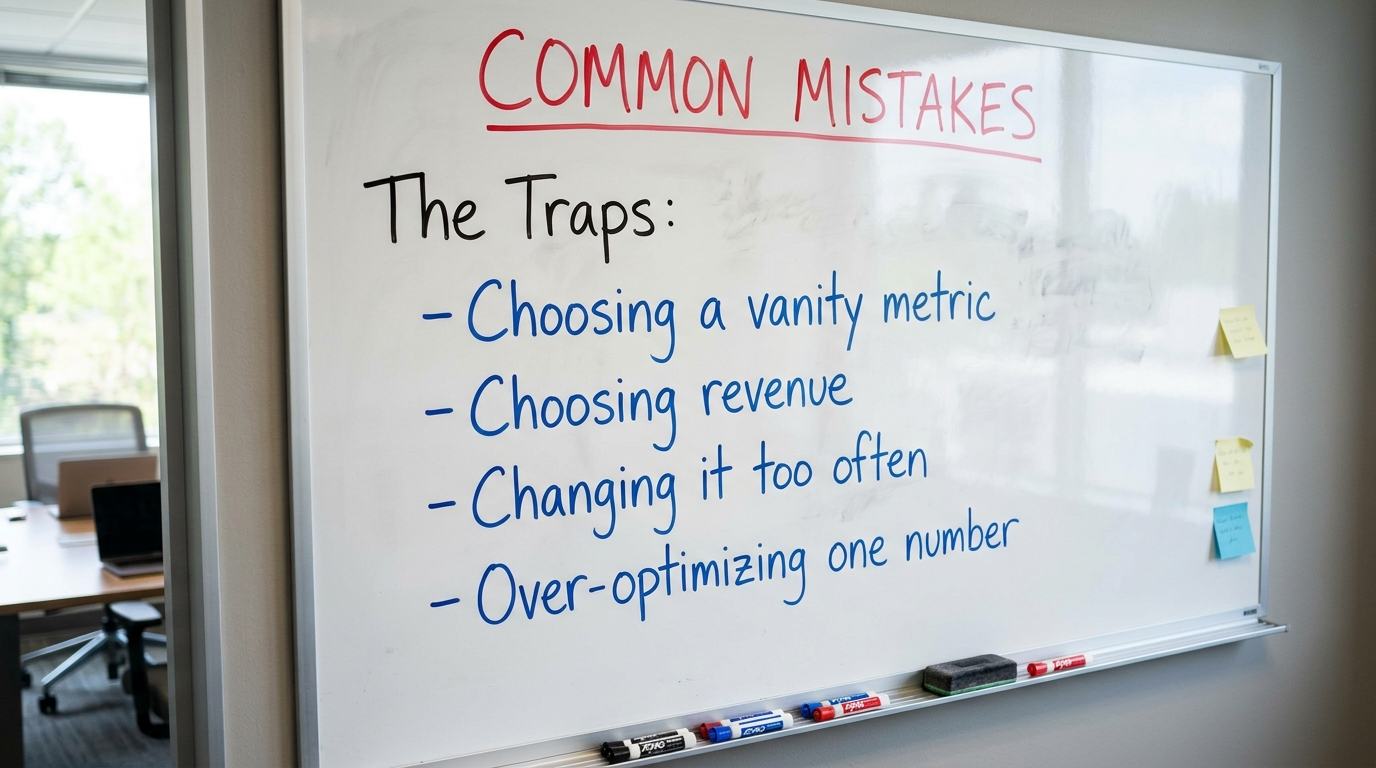
Founders often make the same mistakes when picking a north star metric. The most common one is choosing a vanity metric. Page views or social media followers feel great to watch, but they rarely build a sustainable business. People can follow you for years without paying you anything.
Choosing revenue is another frequent mistake. Revenue rewards you for delivering a good service. It doesn’t measure the service itself.
Changing your mind too often also hurts. If the north star metric changes every month, people stop taking it seriously. Pick one, keep it for at least a year, and let your team run real experiments to improve it. Change it only when the business itself changes, for example, after a major pivot.
Over-optimizing a single number also causes problems. If the only goal is emails sent, marketing may start spamming users. Guardrail metrics prevent that kind of behavior. If your main goal is rides completed, a sensible guardrail is the driver cancellation rate. You want more rides, without service quality dropping.
Finally, roll it out properly. Put the number somewhere everyone sees it, such as a shared dashboard or a daily Slack update. Review it in your weekly meetings and connect it to team goals; our guide to OKRs for startups shows how to turn one company goal into a weekly rhythm. If leadership ignores the north star metric, the rest of the company will too. Celebrate when the number moves, so the team sees that it truly matters.
Frequently Asked Questions
What is a north star metric? If you’re asking what a north star metric is, it’s the single number that best captures the value you deliver to customers. It gives every department one shared focus, which removes a lot of confusion about priorities.
What are some real-world examples? Good examples include nights booked for Airbnb, messages sent for WhatsApp, and weekly active teams for business software. Each measures real value delivered to the user and avoids empty vanity numbers.
How do you choose a north star metric? Pick a north star metric that reflects real customer value and that your team can move directly through product work, feature releases, and marketing. It shouldn’t depend mainly on outside market forces.
Should revenue be your north star metric? Usually not. Revenue is a lagging result of a good product. Your main goal should be a value-based leading indicator. When customers get more value, retention improves, and revenue growth follows.
Find Your One Number, With solvee
Choosing the right north star metric is hard, especially for early-stage companies. Teams spend weeks debating options and still end up with a number that doesn’t reflect what customers value. Most of the time, the real problem sits one step earlier: the team hasn’t fully agreed on who the customer is and what result they get from the product. Without that, every candidate metric looks equally reasonable.
solvee is a personalized AI accelerator that helps founders get those foundations right. It walks you through your customer, value proposition, market, and positioning; scores each one; and shows which gaps are holding the business back. Once you know exactly what value you deliver and to whom, the right number becomes much easier to see. Its advisor knows your strategy so that you can talk through candidates like “weekly active teams” or “orders repeated in 90 days” in the context of your actual business.
The weekly planning and daily focus tools then help keep the team pointed at the number you chose. Each morning, solvee picks the few tasks that move the business forward and explains why, so your work lines up with the metric you’re trying to grow.
Start free with solvee, no credit card required, and find out in a few minutes which gaps stand between your team and one clear number to grow.