
A pre-seed pitch deck relies on about 10 core slides to sell a real problem, a sharp insight, and a founding team worth betting on. Investors move through these 10 slides fast, mostly to see whether you can actually execute, not to dig into financial metrics you don't have yet and honestly aren't expected to.
This article walks through the exact 10 slides you need and what belongs on each one. Set your expectations now; this is a guide about flow and story, not a lecture on graphic design. It's built for early founders raising their very first outside money. Keep reading for a full slide-by-slide breakdown, plus how many slides are too many, what changes once you hit seed stage, and the simple mistakes that end meetings early.
What a Pre-Seed Deck Needs to Prove
What's the actual job of your deck at this stage? With little or zero revenue, your presentation has to prove three things. The problem is painful and real. The market is genuinely big. And your team is the right group to solve it, specifically, not generically.
Copy a Series A presentation at this stage, and it will backfire. Later rounds lean heavily on charts, growth curves, and historical data. At the pre-seed pitch deck level, conviction beats charts every time, because the charts you'd want simply don't exist yet.
You're selling a vision, not a polished business with years behind it. Understanding what investors are actually buying when they open a pre-seed pitch deck matters here. They're buying a credible read on a broken market, and more importantly, a founder who can execute on that read. They want to see you understand the pain better than anyone else in the room, and that you can adapt when the plan inevitably runs into something you didn't expect.
Proving all of that means you can't just throw facts on a page and hope they land. You need a clear story, one slide setting up the next. That's what the actual structure below is for. A proven pitch deck structure guides the investor through your logic instead of leaving them to piece it together themselves.
The 10-Slide Pitch Deck Structure
Here's the ideal pitch deck structure, slide by slide.
- Problem. Explain the pain clearly. Founders often make this too broad instead of naming a specific, bleeding-neck issue someone actually has.
- Solution. Show how you fix the pain. The mistake here is talking about complex tech instead of the plain benefit to the user.
- Why now. Explain why this needs to happen today, not in two years. Don't just say the market is growing; point to a specific recent shift.
- Market size. Show a real opportunity. Founders often ruin this with a giant top-down TAM instead of realistic bottom-up math someone can actually check.
- Product. Show what you built or plan to build. The error is confusing architecture diagrams instead of simple screens or mockups a stranger can read at a glance.
- Business model. Explain how you make money. A common mistake is listing five different revenue streams instead of committing to one core path.
- Traction or proof. Show some momentum, even early. A pre-seed pitch deck still needs proof, waitlist numbers, customer interviews, something, and founders skip this far more often than they should.
- Competition. Map out the real alternatives. Never claim you have no competitors; it just signals you didn't look hard enough.
- Team. Show why you specifically will win. Listing generic degrees instead of relevant industry experience is a fast way to lose someone's attention.
- The ask. State exactly what you need. Vagueness here reads as inexperience, and it shows immediately.
The whole deck should read like a tight argument, each page setting up the next, not a random pile of facts. Two slides carry more weight than the rest: Problem and Team. If the problem isn't urgent, nothing after it matters. If the team looks weak, the idea dies right there. Make sure your ask slide is specific about the total amount and exactly what that money buys you.
How Many Slides Should a Pitch Deck Have?
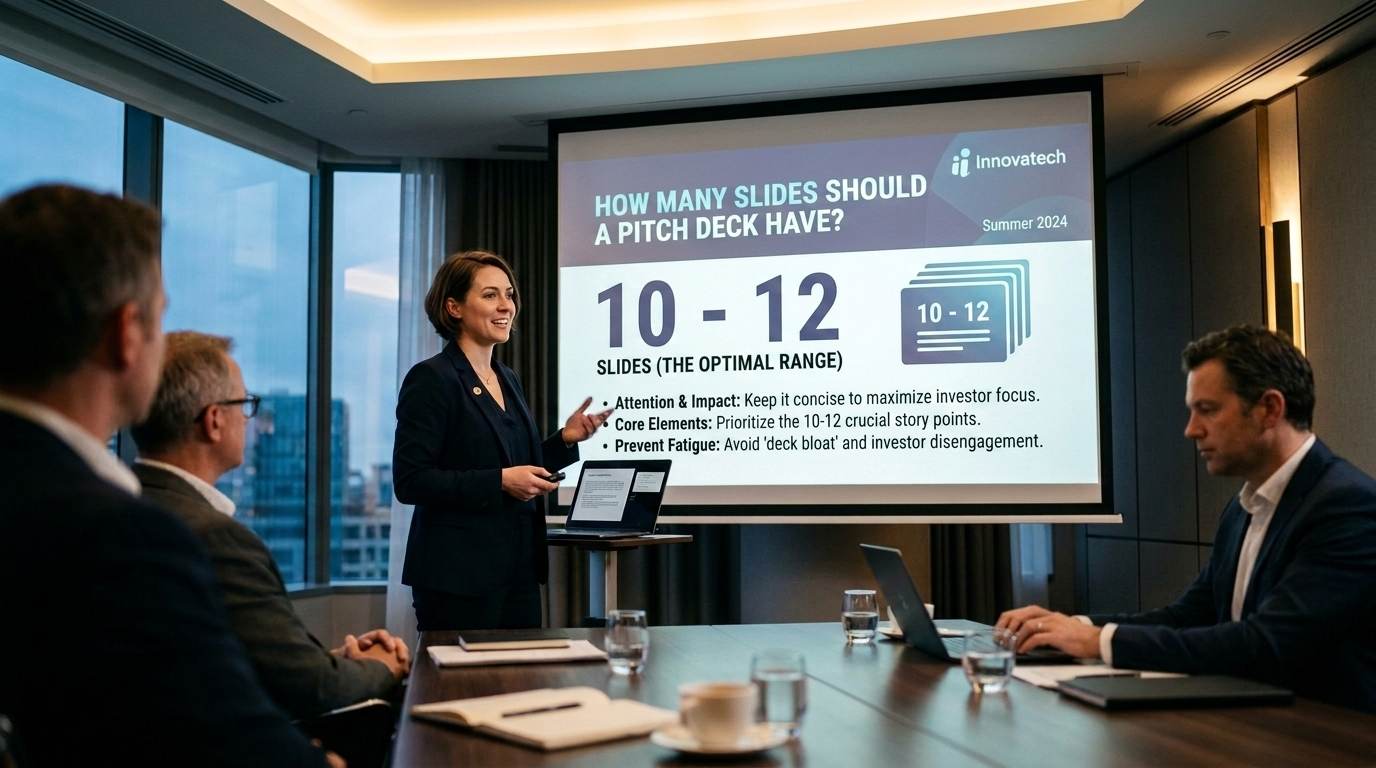
Founders ask this before they even open a template. How many slides in a pitch deck is actually the right number? Aim for 10 to 12 core slides. Treat anything past 15 as a real warning sign that something needs cutting.
The logic is simple. Investors spend a few minutes on each deck they open. Extra pages don't strengthen your story; they dilute it. A longer deck just gives someone more chances to get bored or find a reason to pass. You want their attention locked on your strongest points, not spread thin across filler.
Here's a practical rule. Go through every page. If a slide doesn't clearly advance your argument, cut it. If something's highly technical or deep in the weeds, move it to an appendix instead of the main flow. An appendix is fine for detail-hungry investors who want more after the meeting. Keeping the main deck tight shows you can communicate clearly and that you respect their time.
Pre-Seed vs Seed: What Changes
Comparing your current deck against a seed pitch deck helps you see how the story is supposed to evolve as you raise more.
The shift is noticeable. A seed pitch deck leans much harder on early traction. Investors expect real retention numbers, user growth, and early unit economics by that point. Pre-seed, on the other hand, leans almost entirely on the founder's vision and the team's grit. You're selling the promise of what you'll build, not a track record you don't have yet.
Be careful here. Pitching an early company using a mature seed pitch deck narrative backfires fast. If you talk about deep metrics you can't actually back up with real data, you erode trust in about thirty seconds. Investors already know you're early. Pretending otherwise doesn't help you; it just makes the rest of the pitch harder to believe.
It's completely normal to upgrade the same presentation as your milestones land, swapping vision slides for data slides over time. Next up is a reusable layout you can start building from right now.
A Pre-Seed Pitch Deck Template and Common Mistakes
Starting from a proven pre-seed pitch deck template gives you a real head start. Building on the 10-slide format above saves you from staring at a blank page guessing what investors actually want to see.
You can adapt a solid pre-seed pitch deck template to your specific industry without breaking the underlying flow, as long as you keep the core sections in order. Even with a strong layout, a few mistakes still kill meetings. A buried problem statement that takes too long to land. A fantasy market number nobody believes. Showing up with no clear ask. Cluttered pages with tiny text that exhausts the reader halfway through. A weak team slide that skips the relevant experience.
Before sending an investor pitch deck out into the world, run a quick self-check. Can a total stranger grasp your story in under three minutes with no voiceover from you? If they'd need you in the room to explain what a slide means, the text is too confusing and needs fixing before it goes anywhere.
One more thing worth doing every time. Tailor the deck to match a specific fund's thesis instead of blasting one generic file to a hundred people who all invest in different things.
Sharpen Your Story Before You Pitch, With solvee
Building a strong deck is genuinely hard work, mostly because the hard part isn't the slides; it's the thinking behind them. This is where solvee fits in. It's a personalized AI accelerator that helps founders nail the exact narrative a pre-seed pitch deck depends on, working through your core problem, your market positioning, and your specific "why now" before you ever open a slide tool.
The fit works well for early founders in particular. solvee helps clarify your target market so you sound like you actually know it, not like you're guessing. It sharpens your problem statement until it's uncomfortably specific. And it pressure-tests the whole story so every page on your investor pitch deck has an actual reason to exist instead of just filling space.
Here's the real gap worth naming. Most weak decks aren't a design problem; they're a clarity problem underneath. A beautiful layout can't rescue a confusing business model, no matter how good the fonts look. That's exactly what real strategy work fixes. When your thinking is clear, the slides tend to fall into place on their own.
Want the strategy behind your deck sorted out before you touch a single slide? Get free access to solvee - no credit card, no equity, start today.