
Startups can make money in a few proven ways, and choosing the right one shapes your whole business. These are the eight most common revenue model examples, with the situations where each one fits best:
- Subscription. A fixed fee every month or year, for products people use regularly.
- Tiered SaaS plans. Subscription priced by seats or feature tiers, for business software.
- Transactional. A payment for each purchase.
- Marketplace. A cut of every deal between buyers and sellers.
- Usage-based. Customers pay for exactly what they consume.
- Freemium. A free basic version and paid advanced features.
- Licensing. Other companies pay to use your technology or content.
- Advertising. A free product paid for by advertisers.
Looking at real revenue model examples is the best way to pick the right path for your own company. They save you time and stop you from making bad guesses. If your app saves a person time every single day, charging them a monthly fee makes total sense. If your app helps someone sell an old couch, taking a small cut of that one sale works much better. Match your price tag to the exact moment your user feels happy with your service.
Why the Right Revenue Model Matters
You might have built a great product, but without the right plan, your business will struggle to survive. A revenue model is the simple plan for how you get cash from your users. It determines how you pay your team, how you afford ads, and how you grow the company over time.
Many new founders look at giant tech firms and wonder exactly how startups make money when so many apps seem completely free. Smart companies link their prices directly to user habits. If you pick the wrong way to charge, you can ruin a good product. For example, if you ask for a big fifty-dollar payment upfront for a basic phone app, most people will delete it. And if you charge only one dollar for complex software used by huge banks, you leave too much money on the table. Each path fits a different type of customer, so you need to learn how your customers spend money every day.
Subscription and Recurring Models
Let's start with the most popular choice in the software world today. The subscription model charges users a set fee on a regular schedule. They usually pay you monthly or annually to keep using your service. Companies like Netflix and Spotify use this method for everyday people.
Business software usually adds one more layer. The SaaS revenue model, short for Software as a Service, takes the subscription and splits it into tiers or charges per user seat. Slack, for example, charges teams based on how many people use it and which plan they choose. As a client company grows and adds staff, your revenue from that account grows with it.
Investors like recurring income because it is predictable. This is where terms like Monthly Recurring Revenue, or MRR, come in. When your MRR is steady, you can safely hire new staff or buy more ads without worrying about going broke next week.
However, a subscription model only works if customers need your product all the time. If they only need your help once a year, they will cancel their account after the first month. The recurring path thrives on daily or weekly habits. It works poorly for one-time events, like buying a house or fixing a flat tire. You have to give the user fresh value every single week. Good examples include gym passes, cloud file storage, and meal delivery boxes.
Transactional, Marketplace, and Usage Models
Some businesses fit poorly with a flat monthly fee. Here are three more revenue model examples that rely on what users actually do. First is the transactional method. You charge a simple fee every time a customer buys an item. Standard retail stores and online stores like Amazon use this.
Second is the marketplace method. In this setup, you connect a buyer with a seller and take a small cut of the deal. Companies like Airbnb and Uber use this. Airbnb doesn't own the houses, and Uber doesn't own the cars. Their revenue streams come from making the match and handling the payment. This works well in messy industries where buyers struggle to find sellers on their own.
Third is the usage-based method. Here, you charge customers for exactly what they consume. Think of a water bill: use more, pay more. Cloud computing providers use this. These setups can create large revenue streams over time. As your customer's business grows, they naturally use more of your product, and you earn more without a new sale. These revenue model examples fit businesses where value is tied more to usage than to how long customers stay.
Freemium, Licensing, and Ad Models
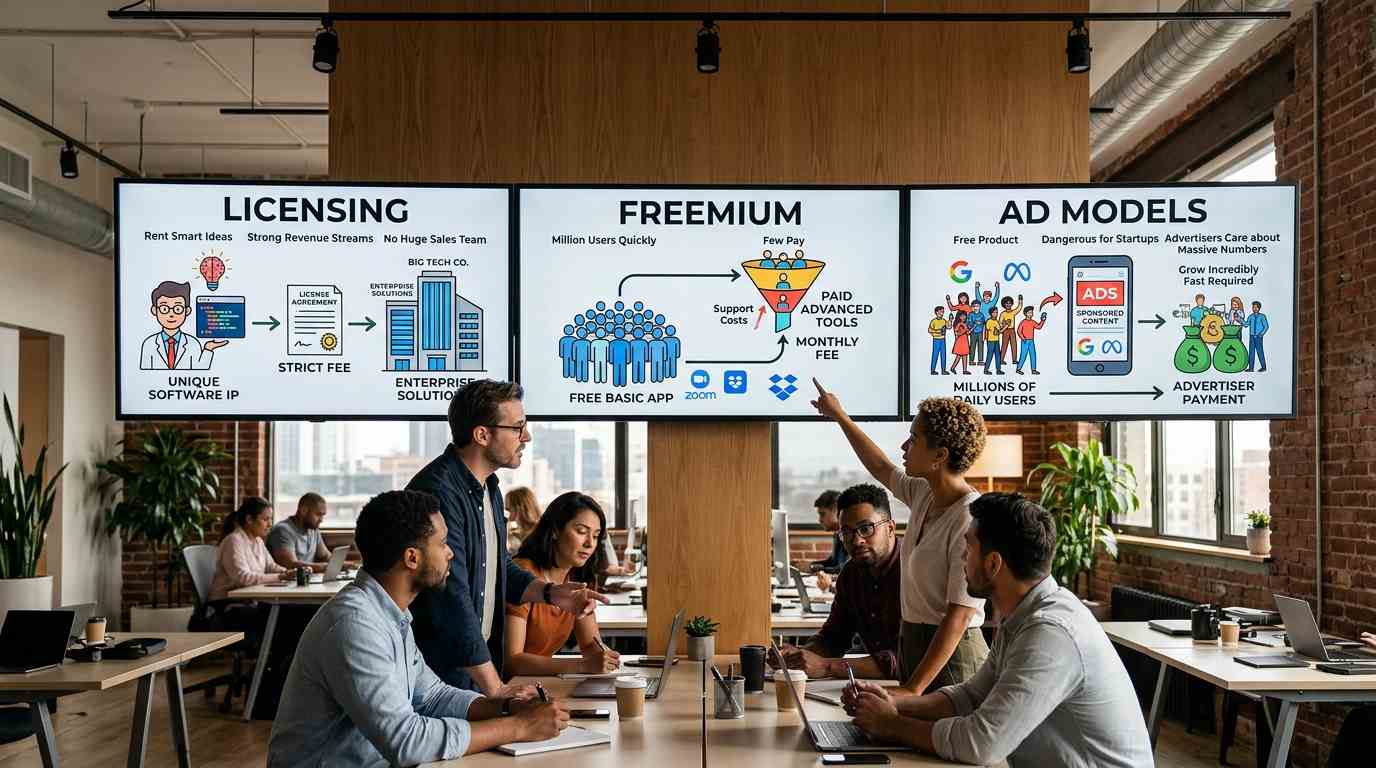
The final three categories are a bit different. They remain powerful business model examples for the right kinds of startups. First is the freemium path. You give away a basic version of your app for free. This helps you get a large number of users quickly. Then, you charge money for advanced tools. Zoom and Dropbox do this well. Keep in mind that supporting free users costs money. You need a big crowd to make it work, because only a small share of people will ever pay.
Next is the licensing method. You create something unique, like software code, a dataset, or a new physical tool. Big companies then pay you a fee to use it in their own products. This can create strong revenue streams without forcing you to hire a huge sales team, since a few large contracts can cover your costs.
Finally, we have the advertising method. You make a free product and show ads to your users. Google and Meta are famous for this. However, you must be very careful. Of all the revenue model examples, it's the riskiest for a brand-new startup. Advertisers pay for very large audiences. If you do not have millions of people opening your app every day, advertisers will pay you very little. Pick this path only if you are confident you can grow incredibly fast.
How to Choose the Right One
So how do you decide? The smartest way is to base your choice on how your customers get value. Look at the revenue model examples above and ask how often your users benefit:
- Every day or every week: a subscription or tiered SaaS plan usually fits.
- During a single purchase or deal: look at transactional or marketplace pricing.
- In amounts that vary a lot from customer to customer: usage-based pricing is worth testing.
- Only during a big life event: charge per transaction.
Test your revenue model cheaply before you spend months building the product. You can make simple test sites with different price tags and see which buttons people click the most. Talk to real people and ask them how they pay for similar things right now. The free market research template gives you a structure for capturing these customer insights and mapping competitors' pricing.
Frequently Asked Questions
What are the main revenue model examples? The main revenue model examples are subscription, tiered SaaS, transactional, marketplace, usage-based, freemium, licensing, and advertising. Each setup serves a different type of business. The best choice depends on how your product gives value to the buyer.
How do startups make money? Understanding how startups make money starts with customer habits. Startups match their price to those habits. They might charge a steady monthly fee, or they might take a small cut of a single purchase.
What is the best revenue model for a startup? The best revenue model is the one that fits your exact customer. It differs from business to business. You have to balance your daily costs with how much your customer is actually willing to spend.
What is a SaaS revenue model? A SaaS revenue model is a system based on monthly or yearly subscription payments, often split into tiers or priced per user. It's mostly used for cloud software. You measure it with Monthly Recurring Revenue and by tracking how many people cancel their accounts, known as churn.
Pick a Model That Fits, With solvee
Now it's time to make a real choice, and solvee helps. It's a personalized AI accelerator that helps you choose based on your business, not generic revenue model examples.
Many founders guess at prices or copy a rival. solvee looks at your customer, your offer, and your market, and scores how clear your revenue model is. If it's weak, it shows up as a gap to fix, along with concrete next steps, such as asking two customers what the problem costs them each month or adding a starting price to your website. Its advisor knows your strategy, so its answers fit your customers.
Stop leaving your pricing to guesswork. Run the free Business Foundation Scan on your website: in about a minute, it scores your customer, value proposition, positioning, and offer, and names the three gaps to fix first. From there, get free access to solvee and build your revenue streams on decisions you can explain.