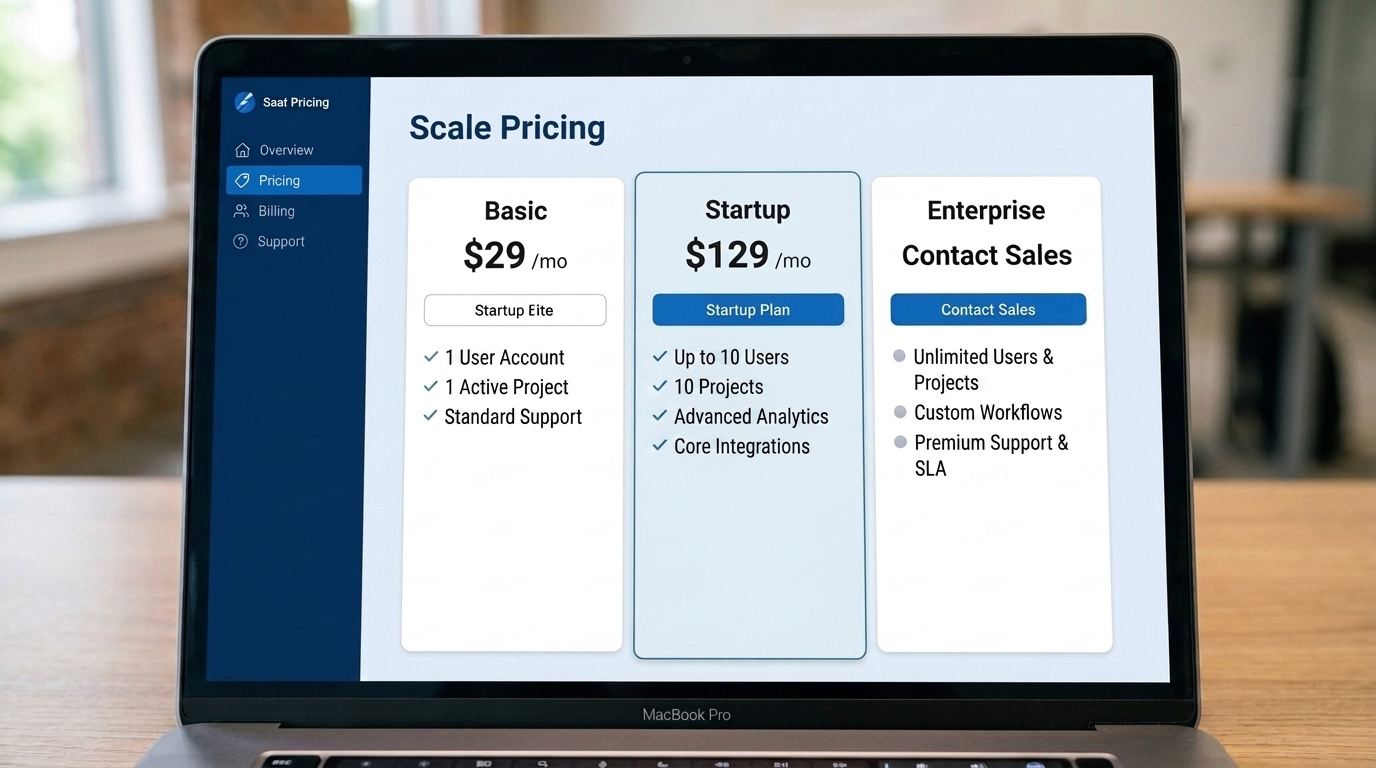
A good SaaS pricing strategy starts from the concrete value you create for a specific customer, not from a random cost-plus guess or whatever a competitor happens to charge. Your first price should reflect the actual outcome your software delivers, not the cost of your servers. Still, there's hardly a more nerve-wracking moment for a founder than typing a final number onto a pricing page. The price is too low, and you starve the company of cash it needs. The price is too high, and you scare people off before you've built any momentum at all.
Take a breath. Here's a practical path through this. The main pricing models available, how to pick the right one for your specific tool, how to choose a startup pricing strategy that actually fits, and how to change it later without making existing customers angry. Worth remembering up front: for early founders, this first price is a starting hypothesis, not a number carved in stone. You'll learn, you'll adjust, and the business will grow around it.
Why Pricing Is a Strategy, Not a Guess
Pricing isn't an afterthought you tackle the night before launch. It acts as a real growth lever for the whole business. Small changes in what you charge compound across every customer you acquire over time. Get it right, and you unlock both faster growth and noticeably better retention.
A lot of founders default to a cost-plus reflex. Look at server costs, add a small margin, call it done. That's a trap worth avoiding. Software costs very little to serve per additional user, so pricing heavily off hosting costs leaves most of the real value sitting on the table, unclaimed. The price was never about what it costs you to build the tool. It's about what the tool is actually worth to the person using it.
The real inputs here are customer value, willingness to pay, and market positioning. That's exactly why pricing naturally follows from knowing your ideal customer well. Understand who they are, and you already understand what they value. The structure you pick today ends up shaping the whole business tomorrow, more than most founders expect going in.
SaaS Pricing Models, Compared
There are a handful of proven SaaS pricing models worth knowing: flat-rate, per-seat, tiered, usage-based, and freemium. Which one fits depends heavily on how your customers actually get value out of the software.
| Model | Best-Fit Case | Main Risk |
|---|---|---|
| Flat-Rate | Simple products with one core feature | Hard to upsell or capture expansion revenue |
| Per-Seat | Team collaboration and workflow tools | Limits adoption; teams may share one login |
| Tiered | Products serving several different buyer types | Can confuse users if feature limits aren't clear |
| Usage-Based | Infrastructure, APIs, consumption-heavy tools | Revenue fluctuates and is harder to predict |
| Freemium | Mass-market tools needing viral adoption | High free-user support costs drain resources |
Usage-based pricing deserves a closer look since it's popular right now, and for good reason. It directly aligns your cost with the customer's perceived value. They pay for exactly what they consume, nothing more. It shines for variable, consumption-heavy products like email senders, payment gateways, or data storage.
The tradeoff is real though. Usage-based pricing can make monthly revenue much harder to forecast. If your customers happen to have a slow month, your revenue drops right along with them, and that unpredictability is worth planning around. It's also worth remembering that usage-based pricing works best when customers can predict their own usage reasonably well; otherwise the bill feels unpredictable to them too.
Tiers and freemium aren't just isolated price points; they're actual growth mechanics. They're built to guide someone up a ladder. A user starts free or cheap, realizes the value, and naturally steps up to a higher tier once the tool proves itself. To match one of these SaaS pricing models to your product, ask two simple questions. How does the customer's value scale as they use more of the product? And what's the most natural thing they'd expect to pay for?
Value-Based Pricing for SaaS

The most effective approach is almost always value-based pricing for SaaS. You set your price against the actual business outcome you deliver, not your monthly server bill and not the nearest competitor's website. It's based entirely on the measurable impact you make on someone's day-to-day work.
How do you actually estimate this? Start by identifying the main metric your product moves. Maybe you save a sales team ten hours a week. Maybe you help an ecommerce store add an extra thousand dollars in monthly revenue. Once you know the real outcome, value-based pricing SaaS lets you capture a fair share of it. Making someone ten thousand dollars and charging them one thousand is a genuinely easy sell, because the math is obviously in their favor.
At the early stage, you can figure out willingness to pay pretty cheaply. No expensive consultants needed. Run customer interviews, test a couple of landing pages, run simple pricing experiments, and see what people actually say.
Compare this to cost-plus or competitor-based pricing. Value-based pricing takes more effort and real customer conversations to get right. But the upside is significant; it stops you from underpricing and quietly starving the business. Worth noting though, this only works once the customer already understands the value you're providing. If they don't see it yet, no pricing model fixes that.
How to Set Your First SaaS Price
How to price a SaaS product for the very first time comes down to a simple sequence. Pick a model that fits how your product is naturally used. Anchor that model to the value you provide. Set clear tiers if you're serving different types of users. Then choose a starting number.
Price it a little higher than feels comfortable. Early founders almost always underprice out of fear of rejection. Price slightly higher and you leave room to offer a strategic discount later if you actually need one, instead of having nowhere left to go.
Thinking through how to price a SaaS product in any specific industry, make sure the price at least covers your basic acquisition costs. But circling back to SaaS specifically, the real goal is recurring revenue and smooth upgrades through your tiers over time. You want someone to buy today and naturally move to a premium tier next year, not stay stuck where they started.
After launch, watch the data closely. Conversion rates, early churn, and one signal people underrate: whether customers say yes too easily. If nobody ever pushes back on the price, that's usually a sign you're priced too low. Treat this first number as version one of your startup pricing strategy, a baseline meant to be tested and revised, not a permanent decision. Don't freeze up trying to get it perfect. Get a real number out into the world so you can learn from how the market actually reacts. That's really how to price your product well: launch, measure, adjust, repeat.
When and How to Change Your Pricing
You'll eventually need to update your numbers. Common triggers for revisiting a SaaS pricing strategy include unusually strong demand, noticing your sales team leaning on heavy discounts just to close deals, or shipping a major new feature. Moving into a new market segment is another good moment to look at the pricing page again.
Handle the actual mechanics of a price change carefully. Grandfather existing customers into their old rate for a set period; they took a chance on you early, and it's worth treating that well. Communicate any upcoming changes clearly and honestly, well before they hit. A solid tactic is testing new prices on fresh signups first, before rolling the change out to everyone.
A lot of founders let fear block them from ever raising prices. They worry about losing the entire user base overnight. In practice, most well-run price increases lose very few customers while meaningfully lifting overall revenue. Treat your pricing models and tiers as a living experiment worth revisiting on a regular schedule, not something you set once and leave untouched for years.
Price With Confidence, With solvee
Pricing feels overwhelming when you're trying to figure it out in a vacuum, disconnected from everything else about the business. This is where solvee fits in. It's a personalized AI accelerator that helps founders connect pricing directly to their positioning and their actual ideal customer, so the final number is grounded in something real instead of a guess.
The fit here is pretty natural. solvee helps clarify the exact value you deliver and exactly who you're delivering it to. That clarity is the foundation every solid SaaS pricing strategy is actually built on. If you can't clearly articulate your value, pricing it accurately is close to impossible.
Here's the real gap worth naming. Founders often freeze on pricing because they're genuinely unsure of their value story, not because the pricing model itself is confusing. They don't know yet what makes them different. That's exactly what real strategy work resolves, and it's what solvee is built to walk you through, so your messaging and your price tag actually line up with each other.
Not sure your price actually reflects your value yet? Get free access to solvee - no credit card, no equity, start today.