
A startup business plan for investors is a short document, usually two or three pages, that answers four questions: what problem you solve, who pays for the fix, how the money comes in, and why your team can pull it off. Investors read it to see whether you think clearly and whether your claims hold up under a quick check. Most of them skim. If the answers aren't easy to find in the first few minutes, the plan has already done its job badly.
Does a Startup Even Need a Business Plan?
Yes, though probably a shorter one than you imagine. Founders often get stuck choosing between a formal 40-page document and a one-page summary. For a startup raising angel or venture money, the answer is almost always the short version, paired with a pitch deck and a simple financial model.
Banks and grant programs often still require long, traditional plans because they check a fixed list of boxes on risk, collateral, and repayment. Venture investors see hundreds of companies a year and want to judge quickly whether yours deserves a meeting. A short startup business plan suits that reality.
A tight business plan for investors also helps you. Cutting a plan down to three pages forces you to decide what really matters, and that clarity shows. When an investor can understand your business in five minutes, they assume you understand it even better. A thick document often signals the opposite: the founder hasn't figured out what matters yet.
The Sections That Actually Matter
Investors expect information in a familiar order, and the business plan sections they actually read are few. Start with the problem: who has it and what it costs them today. Then the solution, meaning what your product does and why it beats the way people handle the problem now.
Next comes the market. How many customers have this problem, and how many of them can you realistically reach in the next two or three years? After that, the business model: what you charge, who pays, and how often.
Then the team. Investors want to know why your group is suited to this exact problem, through industry experience, technical skill, or access to customers. Finally, ask: how much money you're raising and which milestones it will pay for.
Audience matters here. A startup business plan written for investors leans on traction, market size, and team. A plan for a bank leans on risk, cash flow, and the ability to repay a loan: same company, very different emphasis.
Whatever the audience, cut what nobody reads: long company histories, buzzword mission statements, generic industry trends. Each paragraph should explain the business or prove something about it.
How to Write Each Section
Founders searching for how to write a business plan often assume it needs to sound formal. It doesn't. Plain language reads faster and sounds more confident. Keep paragraphs to two or three sentences and use short lists where you're comparing options or naming parallel points.
For the problem section, describe one real customer. A sentence like "Clinic managers spend about six hours a week reconciling supplier invoices by hand" does more work than a paragraph about healthcare inefficiency. For the solution, explain how the product works in terms a non-technical reader can follow, and leave the architecture for the appendix.
The second rule of how to write a business plan is that every claim needs a number or a source behind it. Skip "the market is huge." Explain how many potential customers exist, what they pay today to deal with the problem, and how you arrived at those figures. Build market size from the bottom up: multiply the number of target customers by what each would pay you per year. Investors trust that far more than a top-down figure lifted from an industry report.
Traction deserves the most care, because it's the hardest section to fake. Early sales, a waitlist, pilot agreements, or a group of active users all show that people want what you're building. Customer interviews count too, as long as you report patterns honestly.
A Lean Business Plan Template
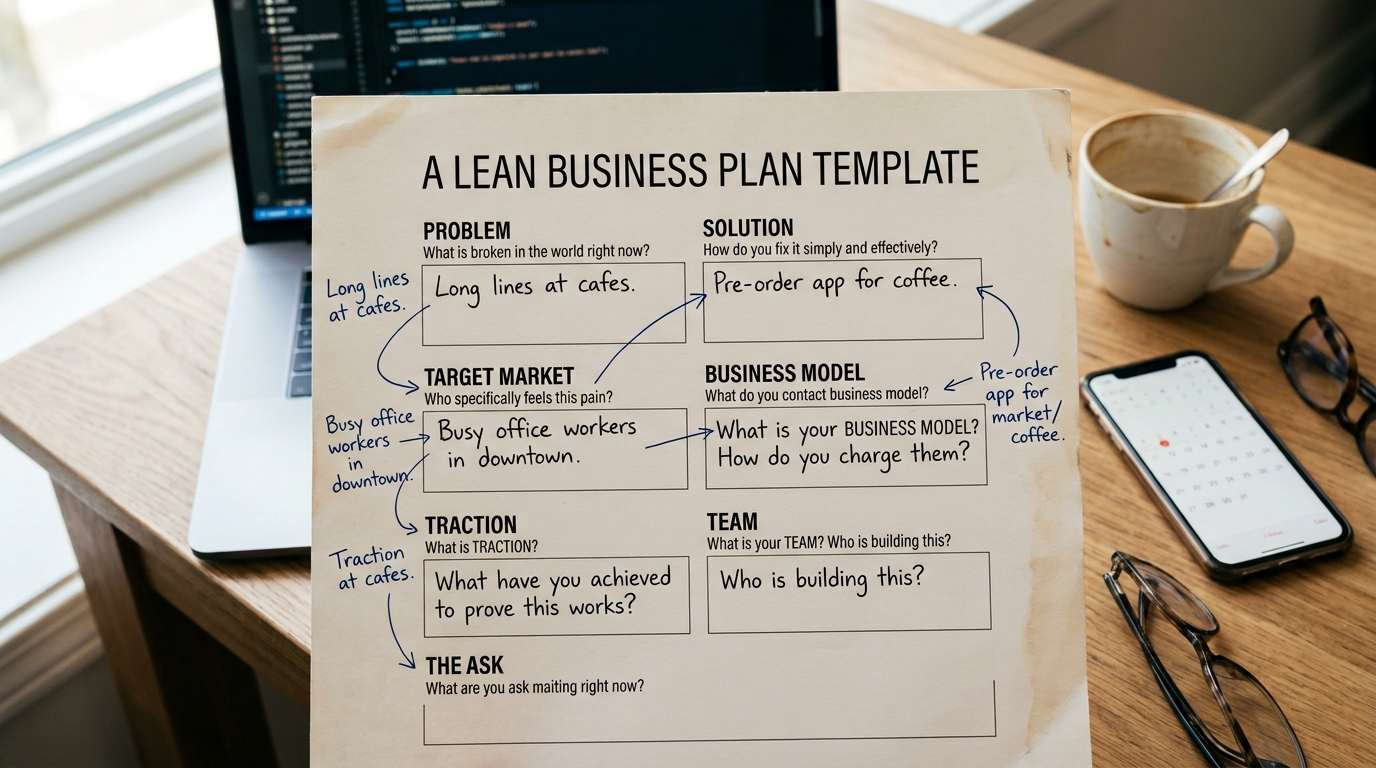
You don't need to start from a blank page. A lean business plan template fits on one or two pages and makes you compress the whole idea into its essentials. Here's a structure that works for most early-stage companies:
- Problem. What is broken right now, and for whom?
- Solution. How your product fixes it, in two or three sentences.
- Target market. The specific group that feels this pain most, and how many of them there are.
- Business model. What you charge, who pays, and how often.
- Traction. What you've achieved so far that proves demand.
- Team. Who is building this and why they're qualified.
- The ask. How much you're raising and the milestones it unlocks.
This startup plan shouldn't stand alone. It has to match your pitch deck and your financial model. If the one-pager says you'll reach 200 customers next year, the spreadsheet should show the same number and the cost of getting there. Investors check, and a mismatch costs credibility fast.
Treat your business plan template as a working document. Update it after every batch of customer conversations, because it will change often early on. Formatting can wait until the facts are solid. A plain, accurate startup plan is worth far more than a beautifully designed one built on guesses.
Common Business Plan Mistakes
The most common mistake is length. When a startup business plan reads like a textbook, investors stop after the first page, and the important parts go unseen.
Claims without evidence come next. Writing "we have no competition" tells investors you haven't looked, since every customer is solving the problem somehow today, even with spreadsheets and email. Unrealistic projections do similar damage. A forecast of $100 million in revenue by year two, with no clear path to the first thousand customers, suggests inexperience. Ground your numbers in what you know about costs and timing; our article on burn rate and runway shows how to work out how long your money will last.
A vague target market is another red flag. "Everyone is our customer" means you haven't found your early adopters yet. Name the first segment you'll sell to and explain why they'll buy first.
Before sending anything, run through a quick check:
- Length. The plan is under three pages.
- Assumptions. Every financial figure has a clear assumption behind it.
- Market. The target market is a specific group you could name and reach.
- Sections. The key business plan sections (problem, solution, market, model, traction, team, ask) are easy to find.
Frequently Asked Questions
Does a startup need a business plan? Yes, but a short one. A focused startup business plan of two or three pages that shows you understand your customers, your market, and your path to revenue serves investors far better than a long formal document.
What sections does a startup business plan need? Problem, solution, target market, business model, traction, team, and the ask. A simple business plan template built on those seven parts covers everything an early-stage investor expects.
How do you write a startup business plan? Go section by section, use plain language, and support every claim with numbers, customer data, or early sales. The core of how to write a business plan for a startup is proving what you say rather than describing it at length.
What do investors want in a business plan? Realistic market sizing, early traction, a capable team, and a believable path to revenue. A good business plan for investors respects their time and leads with the strongest evidence.
Build an Investor-Ready Plan, With solvee
Most weak plans come from writing too early. Founders open a business plan template before they've worked out who the customer is, what the problem costs them, or why they would switch. The document ends up full of assumptions dressed as facts, and investors spot that quickly.
solvee is a personalized AI accelerator that helps you think first. It walks you through the same foundations investors probe (customer, solution, market, and authority), scores each one, and shows exactly which gaps are holding you back. Its advisor knows your strategy and your progress, so when you ask whether your market sizing holds up or which section is weakest, you get an answer about your business instead of a generic checklist. As you complete each step, solvee turns your work into exportable documents, so your startup business plan is built from conclusions you've already tested.
The free plan includes the full foundation assessment and the first journey steps, with no credit card required. Get free access to solvee and see in a few minutes which parts of your startup business plan are investor-ready and which need work.